
Wednesday, August 12, 2026
Don’t Grade Your Social Media on a Test It Wasn’t Built to Pass


You might be feeling frustrated with your social media. You post consistently, your engagement is fine, or maybe even great, and yet, you can't draw a straight line from any of it to a new patient walking through your door. It would be easy to conclude your social strategy is underperforming.
You'd be wrong. You're measuring it against a job it cannot do.
Michael Lau, Co-founder and CEO of [P]rehab (@theprehabguys) and [P]rehab Physical Therapy, understands this better than most. [P]rehab built an Instagram following of more than a million. If reach converted to in-person volume, his Culver City, CA, clinic would have a line out the door. It doesn't, and he's direct about the assumption people keep making. "People are always like, because of that, you guys must have a booming clinic, an in-person clinic, and for all those reasons, no, it doesn't translate to that."
His read on why is based on audience demographics. He has as many clinicians, colleagues, and aspiring physical therapy students as patients following the account. He also sees a structural cause. Social platforms are built to distribute content globally, but practices are built to serve those in driving distance.
"With social media, the power of it is that I can reach someone all the way in South Africa, all the way in Brazil, all the way in China." And then the part that matters for anyone with a lease: "That doesn't matter if you're running a physical practice," he adds.
So why does Lau invest time and effort into social? He highlights the two jobs it does well — neither of which are patient acquisition — and shares how to move your demand-generation budget to where in-person patients actually come from.
Key Takeaways:
- The single feature that makes social media powerful — global reach — is the one feature a practice with a physical footprint cannot use.
- The audience a practice builds is largely clinicians, colleagues, and students, which makes social a recruiting and trust asset rather than an acquisition channel.
- Demand generation for a practice happens in the physical community, and at multiple locations it has to be built market by market.
Step 1: Audit What You're Currently Asking Social Media to Do
Pull your last two quarters of social reporting and sort every metric into one of two buckets: acquisition and trust and recruiting metrics. If acquisition numbers are leading, you're holding the channel accountable for something it structurally isn’t built to deliver. A metrics dashboard that rewards conversions will keep your team chasing a ghost, he cautions.
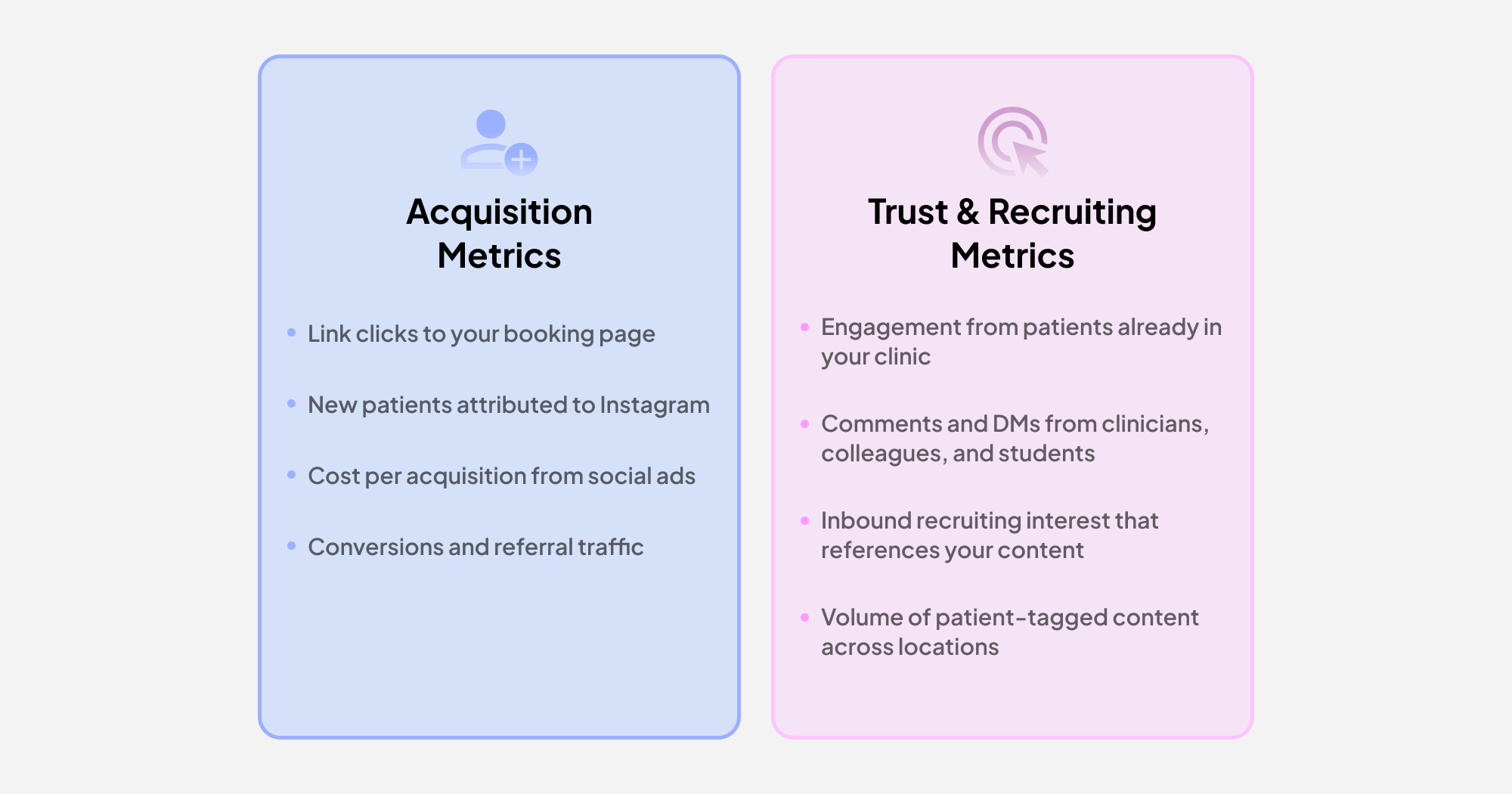
Lau is clear about what the channel actually produces. "The goal of it is just awareness, not necessarily to convert, not necessarily to drive traffic to something. It's just eyeballs, which makes it tough because the ROI on it can seem like it's not there. And it's a long tail ROI."
He frames the value as top of funnel. “You're just supposed to try to get people's attention. That's really all it's for." It changes what you celebrate in your marketing meeting, what you fund, and how your marketing coordinator looks at channel optimization.
Step 2: Reassign Social Media to Two Real Jobs
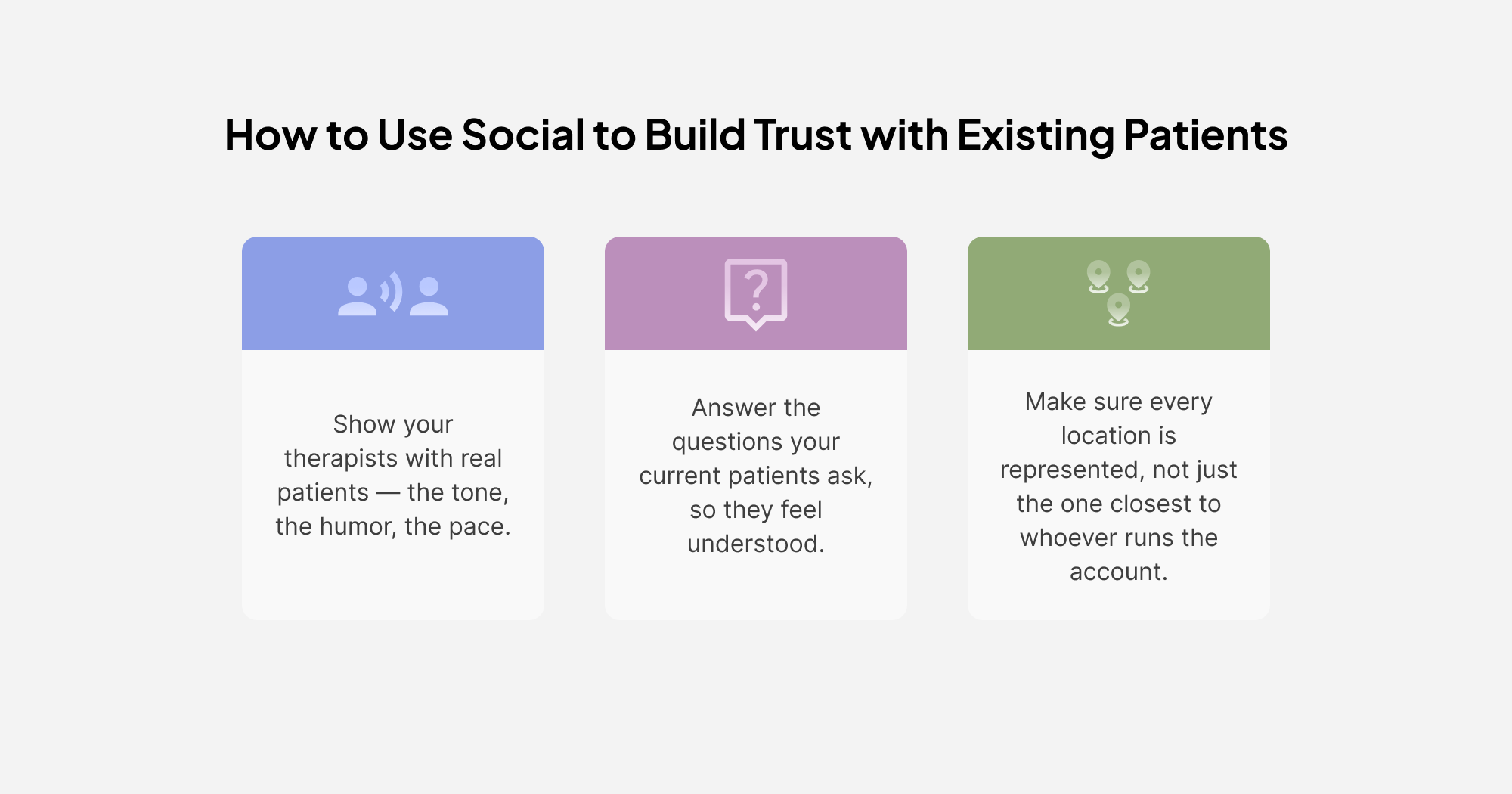
The first job of your social media should be to confirm trust with the patients already in your building. Social media isn't a net you cast to catch strangers. It's a mirror your existing patients look into to confirm they chose the right practice.
"I would argue that social media is less about finding new clients and it's more about: this is what we stand for, this is how we show up, this is my brand, these are my values," says Lau.
He gets specific about who the content is for: "For the patient that already is in your clinic to see how your other therapists are interacting with your patients.” It can be valuable for potential clients in your community, he adds, but emphasizes this as secondary.
At three or more locations this reframe does real work, because it means your content has a job that scales with you. A patient at your newest site should be able to look you up and see the same practice the patient at your flagship sees. Content that shows how your therapists actually interact with patients is the cheapest cross-location consistency signal you have.
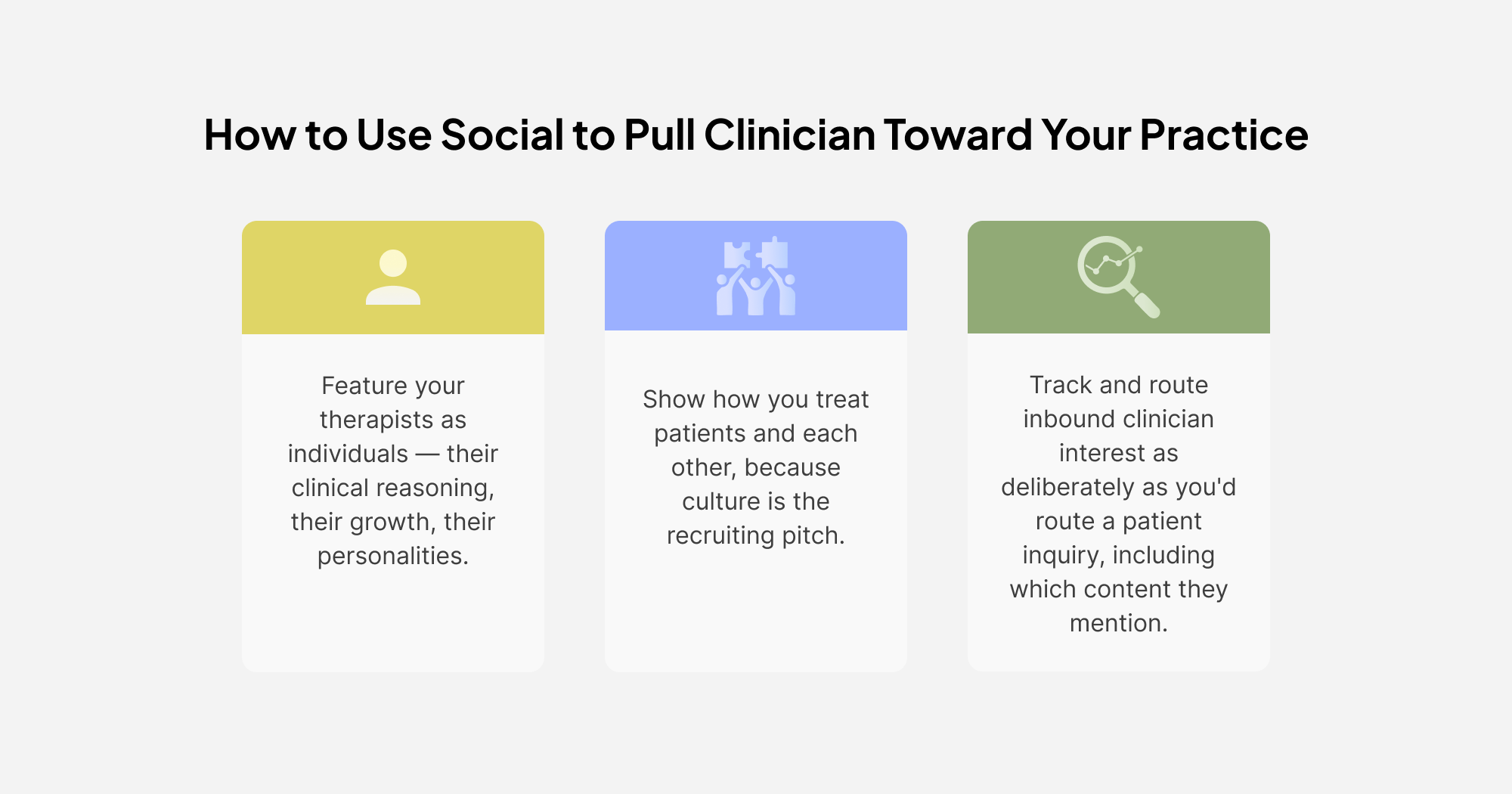
The second job for social is to pull clinicians toward your practice. The constraint on opening location six usually isn't patient demand. It's finding clinicians who fit your culture. That's where a values-forward account earns its keep, because those are the people already watching.
Josh Funk of Rehab to Perform made the same argument in an earlier blog on building a talent pipeline. From the hiring side, organic content can slowly nurture a community of clinicians who aren't actively looking for a new position. Lau’s audience data is the independent confirmation. He finds the people engaging the most with his content are clinicians, colleagues, and students.
Step 3: Move Your Demand-Generation Budget into the Community
If social media isn't your acquisition engine, fund the thing that is. Lau is straight-forward about what that looks like. "Social media is not the place for [demand-generation]. Getting out in your community, doing events with the local soccer club, doing events with the athletic trainers, that's how you actually engage with your community." He advises to put money and effort into:
- Local sports clubs. Soccer clubs, running groups, gyms, youth leagues, as well as screenings and injury-prevention workshops.
- Athletic trainer relationships. ATs are both referral sources and cultural allies. Build real relationships, not transactional ones.
- Adjacent providers. Primary care, orthopedics, chiropractic, performance coaches in your immediate market.
- Events tied to what you're known for. Whatever your clinical differentiator is, there is a local audience already gathering around it.
A physical practice serves a physical geography, so demand generation has to be physically present in that geography — there is no clever way around it. For multi-location practices, that means central marketing can own the repeatable parts: the screening protocol, the collateral, the event templates, and tracking. However, each clinic director owns the relationships in their area.
Ensure tracking is part of this process. “How did you hear about us?" is a key question. You can track if your community building efforts are paying off and double down on what works.
Advice from an expert
Once you’re directing your social toward the right jobs, Lau says there is a single quality bar worth applying to everything you publish. "The way you show up on social media, the way you show up through any sort of digital presence, it needs to be the same as how you show up in person." He adds, "If you are not the same person that shows up on camera, you are going to have some external struggle when you meet someone, and they already have this built up expectation of you because that's what the branding is for social media."
That standard also happens to be your competitive position in the current environment. A prospective clinician or a current patient can tell the difference between a practice that publishes who it actually is and one publishing what it thinks it should be.
Your 30-Day Reallocation
- Week 1: Audit. Sort your social metrics into acquisition versus trust and recruiting. Retire the acquisition metrics from your headline dashboard.
- Week 2: Reassign. Rewrite the social goals around current-patient trust and clinician recruiting, with every location represented. Brief whoever runs the accounts on the new mandate.
- Week 3: Redirect. Build the community calendar. Name the clubs, the athletic trainers, the events, and the owner at each location. Move the budget.
- Week 4: Measure. Add "How did you hear about us?" to intake and set up routing for inbound clinician interest so both new numbers have somewhere to land.
You didn't build a bad social media presence. You aimed it at the wrong target. Point it at the patients already in your building and the clinicians you want in it. Put your demand-generation muscle back where your patients actually live.
Frequently Asked Questions:
Does this mean I should stop posting?
No. It means you should stop expecting social to fill your schedule and start expecting it to do the two things it does well. Reach reinforces a decision a patient has already made, and it puts your culture in front of clinicians who might work for you. What changes is the scorecard and the budget line. If conversion-focused paid social is a line item, that's the money to move first.
How do I tell whether my audience is patients or clinicians?
Look at who comments, who sends DMs, and what your platform analytics say about your followers. If a meaningful share are PTs, PTAs, ATs, and DPT students, you have a recruiting channel whether you built one on purpose or not.
What does a community calendar actually look like across five locations?
Central marketing owns the templates, screening protocols, collateral, and tracking. Each clinic director owns the relationships in their own market, including the clubs, athletic trainers, and events to target. Start with two committed partnerships per location rather than a long list of one-offs, and put the review on a standing cadence so it doesn't quietly lapse when the schedule gets tight.
How long before the reallocation shows up in new patient volume?
Community relationships compound rather than convert, so the honest answer is a quarter or more before the intake data separates cleanly. That's exactly why the intake question and the tracking matter. Without them you'll be making the call on feel, and feel is what got the budget pointed at conversions in the first place.