
Wednesday, May 20, 2026
The Four-Step System for Building a Talent Pipeline


More than 60% of Rehab to Perform's 120-person staff came through the practice before they ever received a job offer.
Josh Funk didn't get there by outspending competitors on job boards. He built a hiring system modeled on the patient acquisition funnel he'd already proven worked. It’s one that runs before he needs it, and functions across 17 locations and contracts with more than 160 DPT programs nationwide.
The physical therapy labor market is getting harder every year: fewer students entering the pipeline, experienced clinicians burning out faster, larger competitors with more recruiting resources. For independent operators, reactive hiring might work at one location. At five, it gets expensive. At 10+, it stops working.
Josh built a system for independent practices that can’t afford to let hiring fall behind growth.
Key Takeaways:
- Every practice is simultaneously running a clinical operation, a marketing company, and a staffing company. Most only have a system for one of them.
- Organic social content, such as behind-the-scenes culture and staff in non-clinical roles, functions as a draw for prospective hires who aren't actively looking yet but might be.
- A student placement is a mutual vetting process. Students who don't fit self-select out before any offer exists.
The Myth of “Good Work Will Attract Good People”
Most independent operators pour their time and energy into patient acquisition, building referral networks, filling schedules, and keeping the pipeline moving. Staff acquisition doesn’t get the same attention.
When a seat opens, a job gets posted. When the job gets filled, the process stops. What that gets you is high turnover, wrong-fit hires, and a recurring problem that never quite gets solved. There's no defined process for building relationships with candidates before a seat is open, no visibility into whether the right people even know the practice exists.
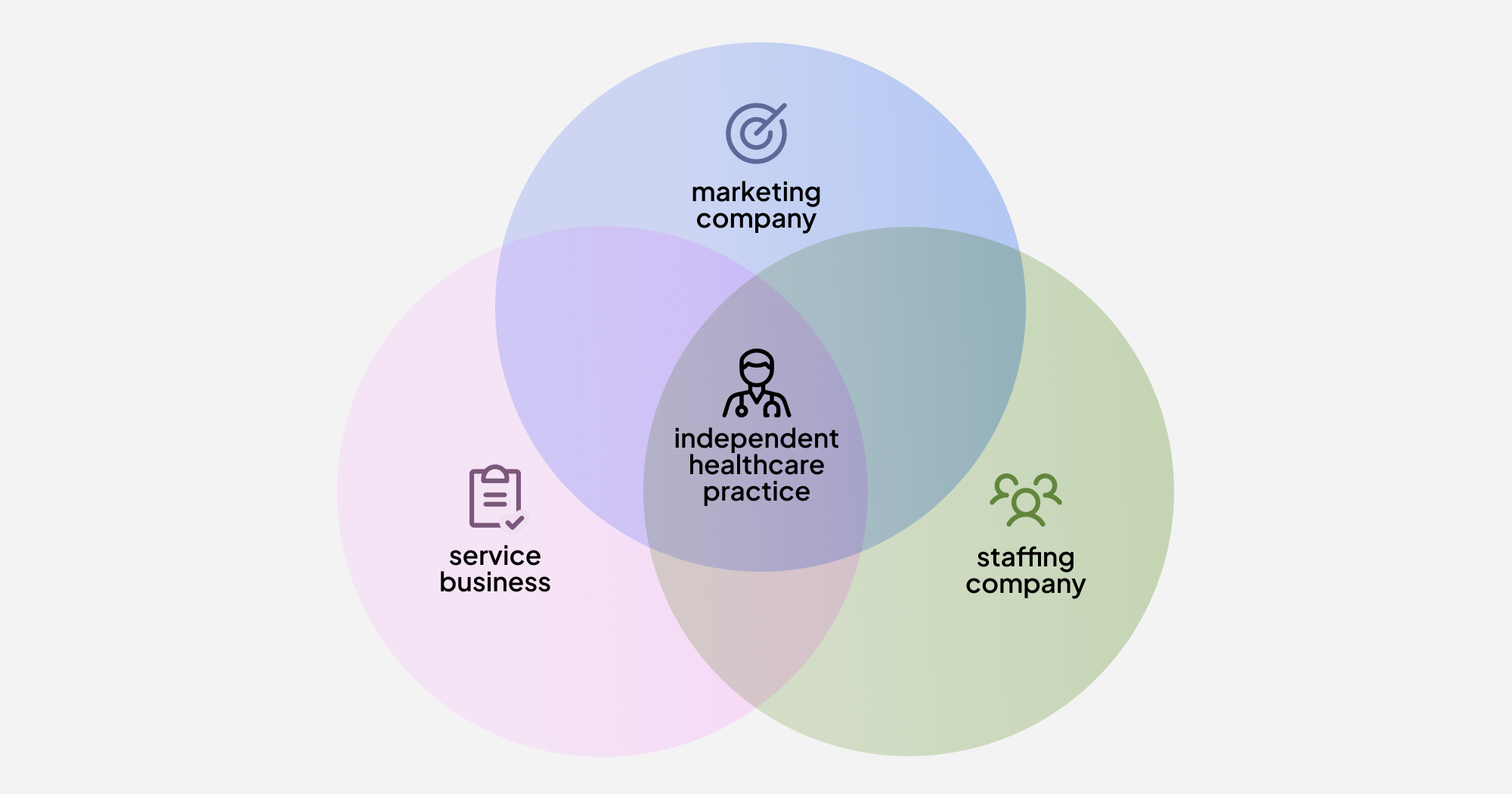
A modern practice is simultaneously running a service business, a marketing company, and a staffing company. Operators have built real systems for the first two out of necessity. The third gets improvised, and in a tightening labor market, that's the one that determines whether the other two can actually function.
You can't treat the patients you acquire if you don't have the staff to see them.
How R2P Built a Staff Acquisition Funnel From Scratch
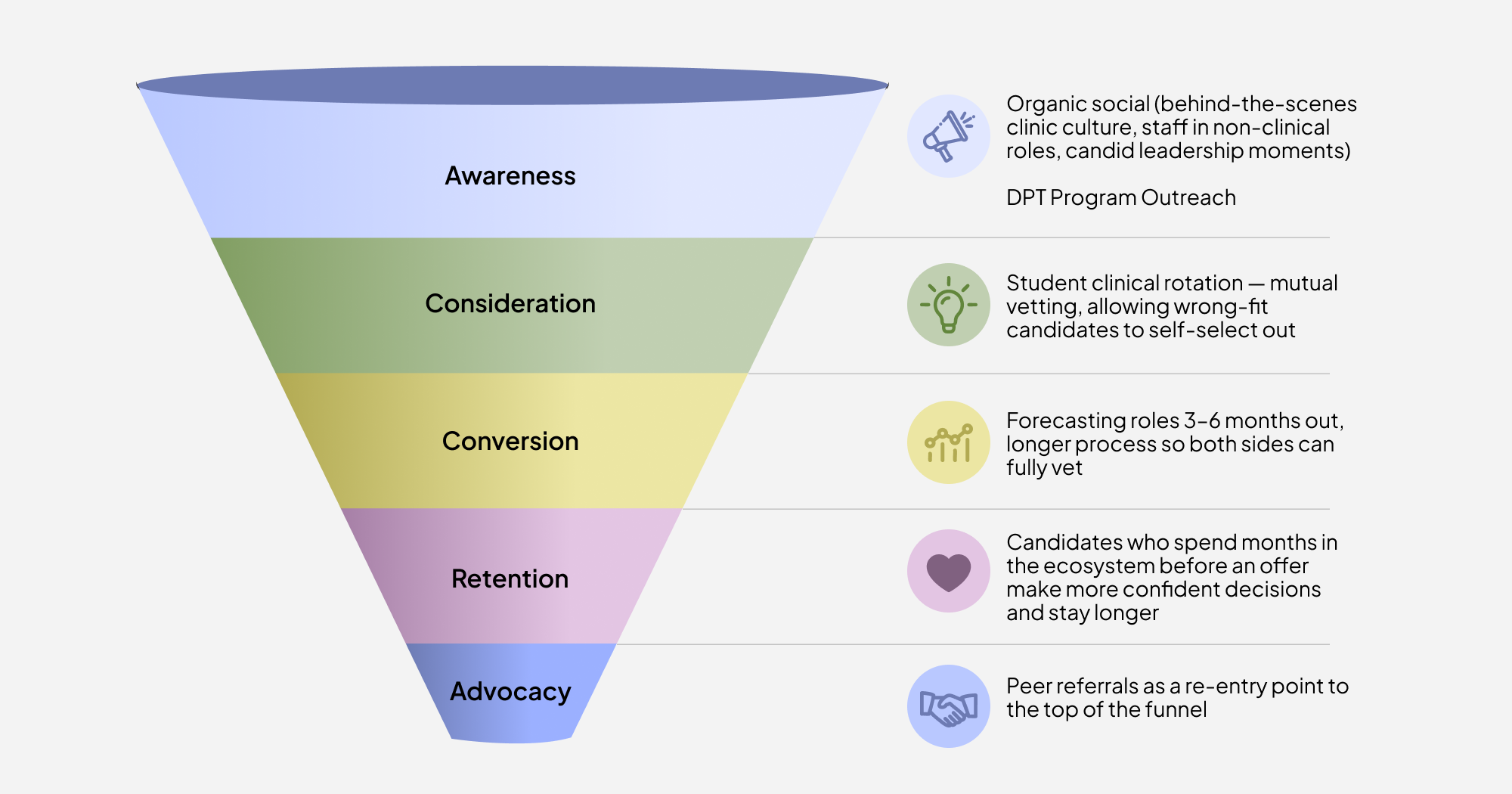
The same principles that work for patient acquisition work for staff acquisition. Practices that build the same relationship engine for staff that they already use for patients are better positioned to hire ahead of need rather than scramble to fill seats in a market that keeps getting tighter.
Josh built a four-step system for building a staff acquisition pipeline. Most practices have pieces of this. Here's how to fill in what's missing.
Step 1. Map your staff funnel like your patient funnel
Josh's first recommendation is to audit your current staffing practices. First, physically draw your patient acquisition funnel. Then, try to draw your staff acquisition funnel alongside it.
Most operators will find the second is blank below generating general awareness at the top of the funnel.
"You see what things you have in place for your funnel when it comes to your consumer acquisition," Josh says. "You should have similar things in place for your staff acquisition—bottom-of-funnel strategies, conversion points, retention points, advocacy points. Most people have never run a marketing funnel for staff. Ever."
You don’t need a perfect answer. The audit itself will help you see where the gaps lie. Every empty space in the staff funnel is an opportunity for you to design something new.
Step 2. Use organic social content to nurture future hires
About three years ago, R2P began intentionally running content for patients and for prospective staff. Josh's view is that paid job postings create rushed conversion dynamics that attract wrong-fit candidates.
Organic content, over a longer arc, builds enough context and trust that candidates often self-initiate.
Focus on content that shows behind-the-scenes clinic culture, staff doing non-clinical work, and candid moments from leadership functions as an extended audition for the practice. Prospective hires are watching before they ever apply.
R2P deliberately shows staff doing social media creation, mentorship roles, and sales work alongside clinical care, signaling that non-clinical growth tracks exist inside the organization.
Step 3. Build the student internship pipeline as a top-of-funnel engine
For R2P, student internship programs were a scalable, top-of-funnel move. They create structured, long-form relationships with prospective hires before job offers are even on the table.
R2P has contracts with more than 160 DPT programs across the country from the Pacific Northwest to Florida to Maine. In any given year, Josh expects R2P will host more than 140 students. More than 60% of R2P's current staff came through the student internship experience first.
"The student internship experience is a try-before-you-buy moment for both sides," Josh explains. "And obviously a great indication that if somebody does want to join us after having a student internship experience, then we must be doing something right there."
The internship also self-selects: students who don't fit R2P's culture or pace discover that on their own during the 8-13 week placement. The ones who stay interested have already passed an informal vetting process.
Step 4. Prepare a longer conversion cycle and forecast roles in advance
Josh's operating principle is that a rushed hire is a retention liability. R2P works to forecast hiring needs 3-6 months out so that conversations with prospective staff can start well before a seat is officially open.
"We love to make sure that there's a longer process in place and that people are able to fully vet us before joining us," Josh says. "If I have a rushed conversion process, I don't have as much confidence in the retention of that person."
A candidate who has been in the R2P ecosystem for months, through content, an event, or even a peer referral, is far more likely to make a confident decision and stay.
What a Fully Built Staff Funnel Produces at Scale
"I already know two people for sure that are starting with us a couple of months from now," Josh says.
Building clear pipelines produces hires who have already experienced the culture firsthand, dramatically reducing the surprise that often drives early turnover. R2P is rarely caught flat-footed on hiring because the pipeline is always active, not just when a seat is open.
Josh’s process reflects a system built on trust, not urgency. When your pipeline is built right, hiring starts feeling more like a calendar event than an emergency.
Frequently Asked Questions:
How do I start building a staff acquisition funnel if I've never done this before?
Start by mapping your current patient acquisition funnel, then try to draw your staff acquisition funnel alongside it. You'll likely find most stages below awareness are empty. That audit will help you see which gaps you need to focus on.
From there, identify which top-of-funnel relationship engine makes sense for your practice size and market. For many independent practices, student internships provide the most scalable entry point because they create structured, long-form relationships with prospective hires before any job offer exists.
What if I don't have the volume to justify contracts with 160+ DPT programs?
You don't need 160 programs to start. R2P built to that scale over more than a decade. Begin with DPT programs in your region or state and focus on delivering an exceptional student experience. Even hosting 10-15 students per year creates a meaningful pipeline. The try-before-you-buy dynamic works at any scale.
How do organic social posts actually attract staff if I'm not explicitly posting job openings?
Organic content functions as a slow-burn nurture sequence for mid-career clinicians who aren't actively looking right now but might be open to a change. When you show behind-the-scenes clinic culture, staff doing non-clinical work, and candid moments from leadership, prospective hires are watching and forming opinions before they ever apply.
This extended exposure builds context and trust that paid job postings can't create. Candidates who spend months following your content often self-initiate the application process and already know whether they’re a good fit.
What's the actual timeline for implementing this system in my practice?
The staff funnel audit (Step 1) takes an afternoon.
Organic social content creation (Step 2) can start this week if you have staff willing to participate. Building student internship contracts (Step 3) can begin immediately: reach out to DPT program coordinators in your region and offer placements for the next academic cycle.
Forecasting hiring needs 3-6 months out (Step 4) requires looking at your growth plan and current staff tenure data.
You won't have a fully functional system overnight, but you can have top-of-funnel activity within 30-60 days.