
Tuesday, June 30, 2026
Your Practice Was Always a Hospitality Business

If you run an independent practice, you've probably been told to fear AI. The headlines suggest robots are coming for your staff, and that the only way to survive is to cut headcount before your competitors do. That framing is wrong — and acting on it will cost you.
The actual threat is quieter and more corrosive. It's a labor market where qualified hires are genuinely scarce, layered on top of decades of administrative bloat that has buried the human side of care under paperwork, faxes, and repetitive busywork.
“We have a far greater problem at the moment … a huge shortage of folks that can work at these practices across the country,” says Eric deRegt, Chief Technology Officer at Indie Health. The question isn't how to replace your people. It's how to free up their time.
Eric says the practices that win the next decade will think of themselves as hospitality businesses. They'll use technology to strip out the work nobody wants to do, and reinvest that recovered capacity into the patient experience.
Key Takeaways:
- The real threat to independent practices isn't AI replacing staff — it's a labor shortage and the administrative bloat that has buried the human side of care.
- The work technology should take on is the repetitive, judgment-light tasks nobody wants, so your team's time goes back to patients.
- Human connection is the one advantage that is hard to manufacture at scale. Reinvest the recovered capacity there, and that's where you win.
You Are in the Hospitality Business
Start with a mental shift. Most independent owners describe themselves by their clinical specialty — physical therapy, dental, behavioral health, primary care. That's accurate, but it's not where your competitive advantage lives. Your advantage lives in how a patient feels from the moment they call to the moment they leave.
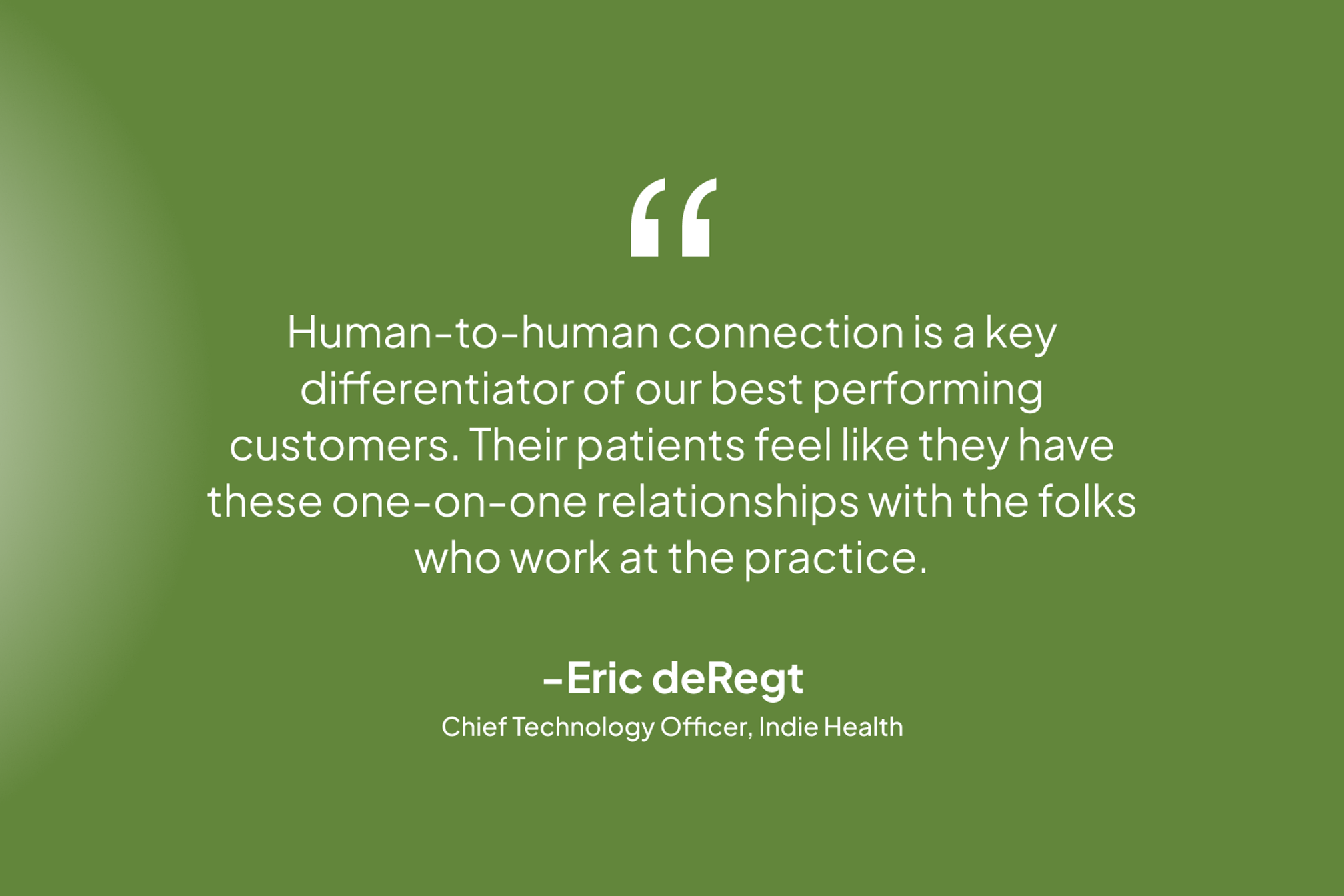
Eric sees this play out at Indie Health. “Neither practice owners nor patients want an experience where the patient comes into the office and they're just interacting with a staff of robots and AI tools. This human-to-human connection is a key differentiator of our best performing customers. Their patients feel like they have these one-on-one relationships with the folks who work at the practice.”
That summarizes the whole strategy. Your best-performing future looks like a practice where patients feel known. The role of technology is not to insert itself between you and the patient — it's to clear the runway so that connection can happen.
An Advantage Scale Can't Standardize
Scale, standardization, and cost are real advantages in the back office. But hospitality is the opposite of standardization. It's the relationship a front-desk coordinator has with a patient she's checked in forty times. It's the clinician who remembers your daughter's name. You can't engineer that, and it is extremely challenging to manufacture across three hundred locations using a corporate playbook.
“Many practices can think of themselves more for their brand and hospitality experience they offer their patients — really differentiating on that side — and not having to worry so much about some of these back-office-type challenges,” deRegt says.
That last piece is the key. Hospitality is only sustainable if your team isn't drowning. Which is where technology comes in.
Where Automation Is Genuinely Ready
Not all AI is equal, and not all of it is ready. The discipline here is matching the tool to the task. “The type of work that AI is best at replacing is the stuff that people don't want to be doing anyway,” Eric says. “And if you can go into work and be creative and be with patients and collaborate with your teammates, you can really drive differentiated experiences for your patients.”
Document Processing Is the Strongest Use Case Right Now
If you want a place to start, start with paperwork. “If you look at referral management, eligibility checks, things like that — anything where there's document processing is a really strong use case,” Eric explains. You can present these systems with unstructured PDFs, faxes, and so on that they've never seen before, and they can pull out data into a structured format.
This is the unglamorous engine of every practice: faxes that need to be read, referrals that need to be routed, eligibility that needs to be verified before a patient ever walks in. It's high-volume, repetitive, judgment-light work — the perfect profile for automation.
Your staff don't want to do it, and the cost of getting it wrong is mostly rework, not patient harm.
Voice Agents for Overflow and After-Hours
While voice agents are less mature than document processing, they are improving rapidly. The smart deployment isn't to replace your front desk — it's to catch what your front desk can't, including overflow calls during busy hours and after-hours inquiries that would otherwise go to voicemail and become tomorrow's missed appointment. This is capacity you don't have and can't easily hire for, handled by a system that augments rather than substitutes.
The Limits of the Technology — Be Honest With Yourself
The hospitality strategy depends on you knowing exactly what these systems can and cannot do. Overestimate them and you'll degrade the patient experience you're trying to protect.
The fundamental limit is judgment. “These models don't have human judgment, and there's not really any indication that they will get there in a number of important ways,” Eric says. That's not a temporary gap that next year's model closes.
Any task where judgment, nuance, or genuine empathy is the value stays with your people. And because these systems do make mistakes, keep a human on anything consequential. That's not a limitation to engineer away — it's the boundary that keeps the human part of care human.
Eric offers a clean framework for sorting your work. “You want to look for known process issues that I want to improve in my practice that require human judgment and cooperation. Then, look for either hair-on-fire problems or very well-defined tasks that you don't have enough capacity to handle, or are just wasting people's time and they hate doing.”
Across the whole practice, the burden is everywhere. “There are these huge areas of administrative burden and waste that are just present every day,” says Eric. Talk to your team about their pain points — the things they’re doing over and over again that are repetitive, that don't add value, and that they just wish they could get rid of. Ask your team what those are. They already know.
Putting It Together: Your 90-Day Approach
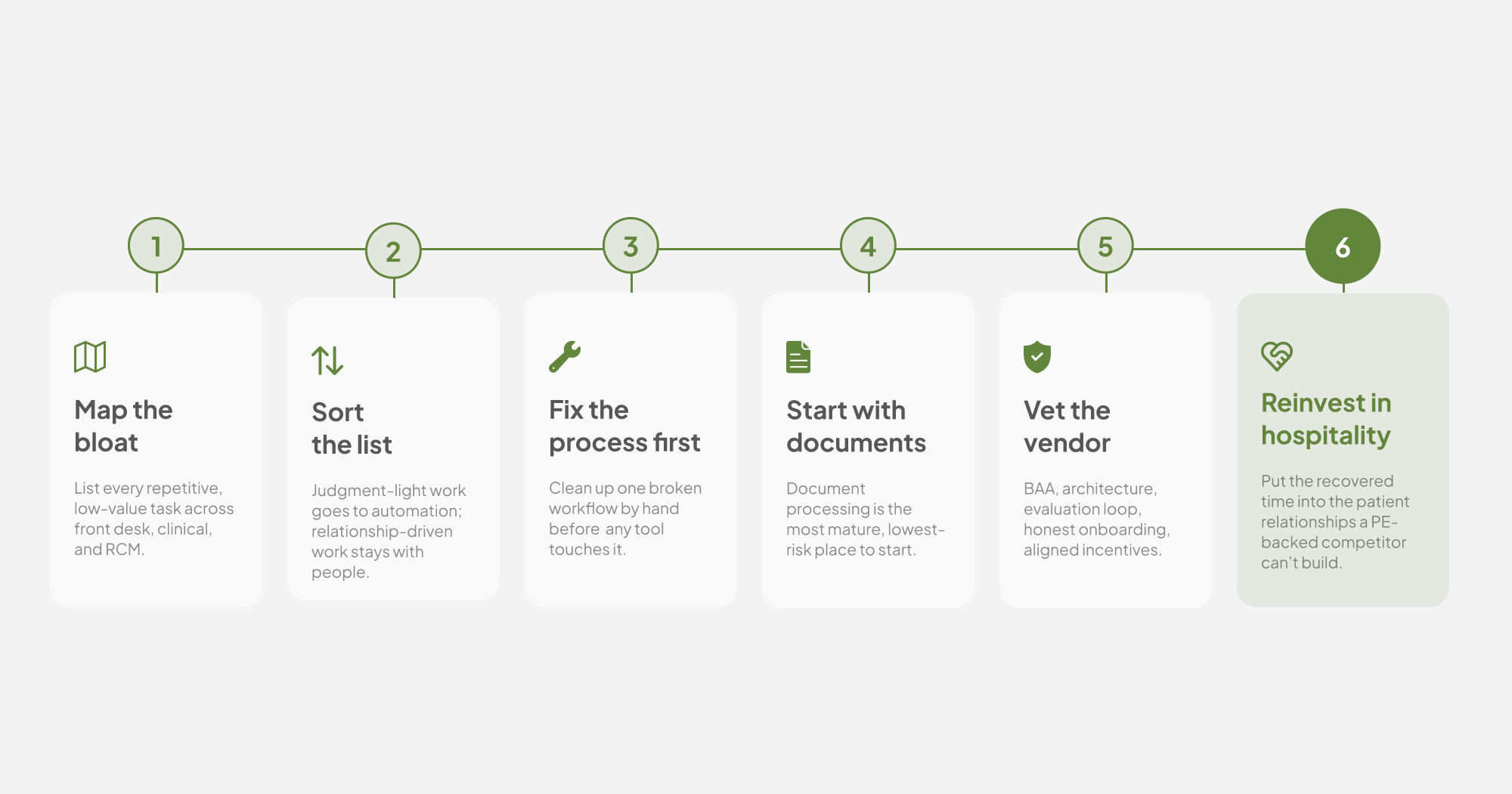
You don't need to transform everything at once. You need a disciplined sequence.
First, map your administrative bloat. Ask front desk, clinical, and RCM staff for their personal list of repetitive, low-value tasks. You'll find the patterns fast.
Second, sort the list. Well-defined and judgment-light goes in the automation bucket. Judgment-heavy and relationship-driven goes in the protect-and-improve bucket.
Third, fix processes before you automate. Pick one broken workflow and clean it up by hand before any tool touches it.
Fourth, start with document processing. It's the most mature, lowest-risk, highest-leverage entry point.
Fifth, vet the vendor itself — BAA, architecture, evaluation loops, honest onboarding, aligned incentives. That's a discipline of its own. (Read Eric’s four-part test for vetting an AI vendor.)
Sixth, reinvest the recovered capacity into hospitality. This is the whole point. The time you free up doesn't go back into the margin spreadsheet — it goes into patient relationships.
The future of independent practice isn't a choice between staying human and adopting technology. It's using technology so you can be more human than the competition can afford to be.