
Wednesday, June 3, 2026
When the Founder Can No Longer Be the Brand


Josh Funk was the brand. For the first several years of Rehab to Perform's (R2P) existence, he could walk into any room, read the situation, and have patients feel the company's identity through his presence alone.
When you have two locations, this works. After 11 years, almost 20 locations, and 120 employees later, R2P is one of the larger independent MSK groups in its market. At that scale, a founder can’t be everywhere to embody the brand.
That’s why Funk's brand guide just hit 47 pages.
That document began as fewer than 10 pages, built by hand using a fitness chain franchise guide as a structural model. What happened between those two versions is a blueprint for any independent operator who wants to stop being a roadblock for the growth of their practice.
Key Takeaways:
- Most practice owners define their brand through their visual identity. At scale, it needs to go beyond that. It's an operational system.
- The founder-as-brand model breaks down at a specific growth threshold and leaves a ceiling in its place.
- Brand standards that feel overly strict at 3 locations are the right standards for 12.
Where Practice Operators Struggle with Brand
There's a version of brand strategy that most independent practice owners have implemented: a logo, a color palette, maybe a tagline. But that isn't infrastructure. That makes your brand recognizable, but the two are not the same thing.
Brand infrastructure is what happens when a patient walks into Location B and has the same experience they had at Location A. Different practice locations should feel like they’re part of the same company as it scales across markets.
At a few locations, the founder can usually catch this. They’re still physically present enough, still visible enough, to course-correct. At 10 locations across multiple markets, that doesn’t happen, and that’s when patients start to get varied experiences.
The result of the latter scenario is what Funk calls a chaotic brand experience, or more precisely, an unpredictable one. Patients don't consciously think "this brand is inconsistent," but they feel something is off. That perception of unpredictability can degrade trust so much so that patients stop giving referrals to their communities.
Founders who don't build this infrastructure create a growth ceiling tied directly to their own capacity and availability. The transition from founder-as-brand to documented brand system is one of the most consequential operational shifts a scaling practice will make.
The best time to start is earlier than feels necessary.
The Three-Phase Transition Every Scaling Practice Goes Through
Funk's path from (1) founder-as-brand to (2) a documented brand system to (3) embodying brand-as-organizational-discipline follows a pattern that independent operators across MSK can follow.
The end state is a practice where every patient interaction reinforces the same identity, every new hire absorbs the same culture, and the founder's absence from any given room stops being a liability.
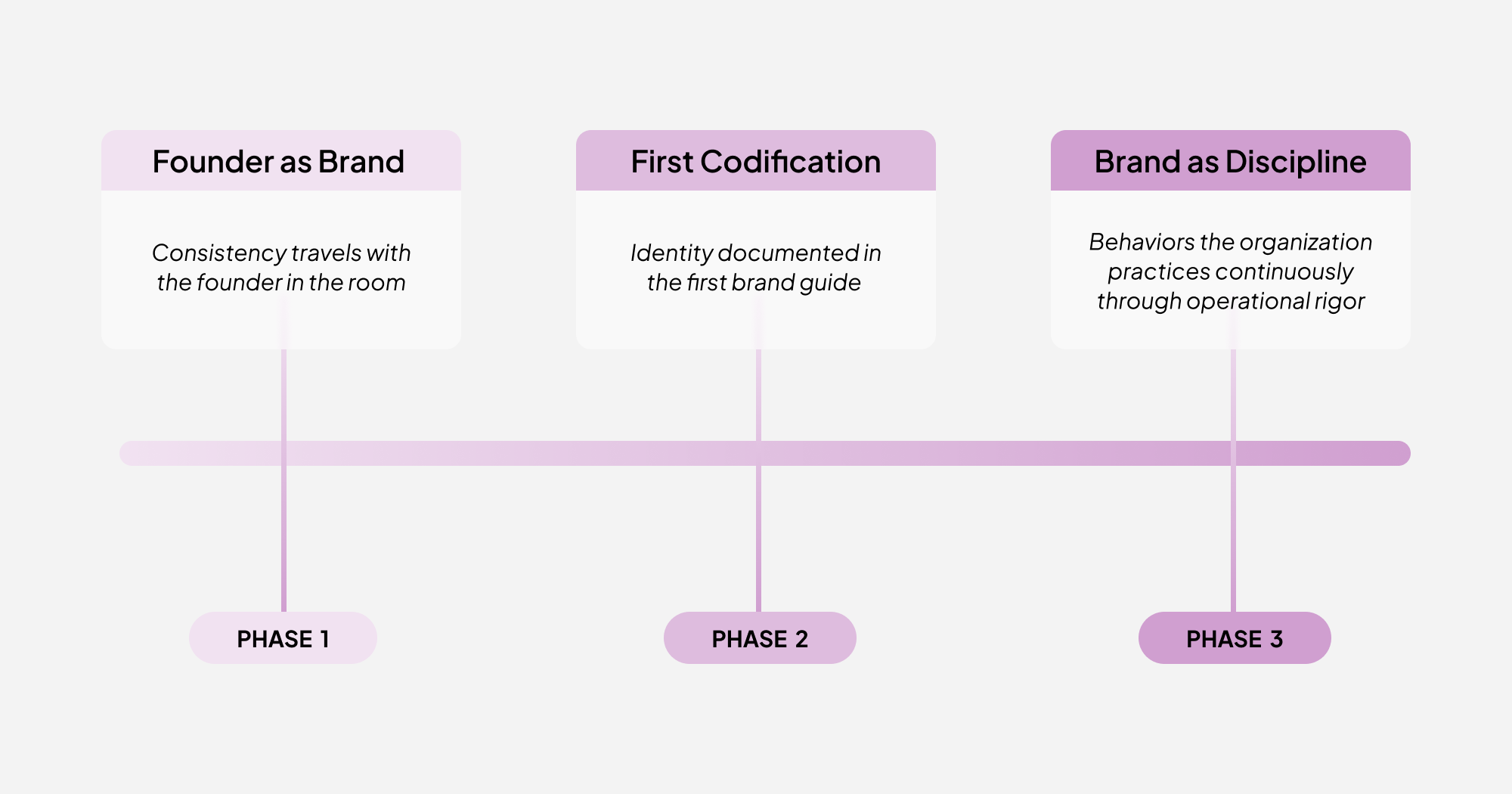
Phase 1: The founder is the brand
Before the pandemic forced R2P to build almost exclusively in the digital space, Funk was what he calls the "omni-channel marketer." He could walk into a physician’s office, a community event, or a staff meeting and carry the brand through personality alone.
This is not a failure mode. At a small scale, it works, but naturally, a strong practice grows. And not everything can grow with it.
"At some point the founder can't be the messenger anymore."
Phase 2: The first codification
When R2P needed to go digital to reach a wider market during the pandemic, Funk didn't hire an agency. He built R2P's first version of a brand guide to emulate what he knew from a local fitness chain. Visual identity, core language, and a clear statement of what the practice stands for is a good starting point.
It was under 10 pages, it was imperfect, but it was done. All you need to start your brand documentation is the decision that the organization is ready to be consistent.
Phase 3: The brand as discipline
Most practice owners situate the brand in the marketing department and stop there. Funk locates it in onboarding, daily language, how leaders talk about the patient journey, and what a new hire absorbs in their first 90 days.
A brand guide is a document. Brand consistency is a behavior the organization practices continuously, and that requires the same operational rigor as any other system. That's why, at the start of 2025, Funk presented R2P's 47-page guide to all 120 employees — a signal that brand standards are an organizational priority, not a marketing department concern.
"You have to get stricter and stricter," Funk says. "Your guardrails have to get narrow. The floor has to rise.”
The end state Funk is building toward are patients who become raving advocates because every touchpoint has reinforced the same identity.
"Who do you want to eventually become the biggest advocate of your brand? The patients. They need to be a walking, talking brand ambassador. And they only get that way if they know your brand inside and out."
A Market Pushing Urgency
Independent MSK practices are operating in a market where brand infrastructure has gone from a competitive differentiator to a baseline requirement.
Private equity consolidation
PE-backed groups entering local markets arrive with professionally managed brands, consistent patient experiences, and marketing budgets that independent operators can't match dollar-for-dollar.
What PE-backed groups cannot manufacture, though, is authentic local identity: known practitioners, community presence built over years, a reputation that predates their arrival.
Those things are the raw material of a genuinely differentiated brand, but only if they're captured in the infrastructure. Independent practices that have done that work are harder to displace because they have something consistent to point to.
The digital content environment
AI-generated content is making the web faster, noisier, and more homogeneous. Practices that have clearly documented, consistently expressed brand identities will be harder to confuse with a corporate system's output.
"In a world where AI is probably going to make things overly curated and too professional, I think there's a certain amount of authenticity that people are looking to see," Funk says.
The practices positioned to benefit from this are the ones that have already done the work of defining what authentic looks like for their organization.
For hiring, the same logic applies. DPT graduates choosing between a well-resourced health system and an independent practice are making a brand decision whether they know it or not. A clear, consistent, compelling identity — visible across social content, student internship experience, and leadership presence — is going to influence where talented practitioners end up working.
The Operational Habits Behind a Consistent Brand at Scale
Most practice owners plan to build brand infrastructure eventually. They'll get to it once the next location is open, once hiring stabilizes, once there's more bandwidth.
Funk's experience at R2P tells a different story: there is no version of starting too early, and there are real costs to starting late.
"Even if you don't think you have a lot of time or you're not good at it, just start earlier," he says. "There's literally no negative to starting earlier."
The cost doesn't show up on a balance sheet. It shows up in patients who feel something is off at a second location and stop referring. In new hires who absorb their manager's interpretation of the brand instead of the organization's. In a practice that can only be as consistent as the founder's availability allows.
That last part is worth sitting with. Every brand plateau is a founder plateau. The organization can only grow as consistently and as intentionally as the leader driving it.
Founders who treat brand-building as an operational discipline, not a marketing project, are doing the most important leadership development work they can.
Frequently Asked Questions
What's the difference between a brand guide and brand infrastructure?
A brand guide is a document that includes logos, colors, fonts, maybe some language guidelines. Brand infrastructure is the operational system that makes the brand guide real across every location, every new hire, and every patient interaction.
It lives in onboarding, in how leaders communicate about the patient journey, and in how consistently staff describe the practice to patients across markets.
Funk's R2P brand guide grew from under 10 pages to 47 not because the visual identity changed dramatically, but because the operational specificity required to maintain consistency at 120 employees is fundamentally different from what it required at 20.
When should an independent practice start building brand infrastructure?
Earlier than feels necessary. Most operators wait until brand inconsistency becomes a visible problem: a patient complains about a different experience at a second location, or turnover prompts a look at culture. By then, the cost of correction is higher.
Funk's advice: even a rough, imperfect document built in the early stage of growth is better than a polished guide built reactively at scale.
The decision that the organization is ready to be consistent is the starting point. The document follows from that decision.
How does brand infrastructure affect hiring for independent MSK practices?
DPT graduates choosing where to work are forming opinions about employers long before they apply. A practice with a clear, consistently expressed brand identity — visible through social content, student internship experience, and leadership presence — gives candidates something to evaluate.
Funk's approach to brand is inseparable from his approach to recruiting: the same consistent identity that makes patients into advocates also makes prospective hires confident in their choice to accept a position. Candidates who have followed an organization for months before applying aren't making a blind decision.
How do you maintain brand consistency as headcount grows past 50 or 100 people?
The key is making it stronger incrementally instead of trying to fix it all at once. Funk presented R2P's 47-page brand guide to the full organization at the start of 2025: a signal that brand standards are an organizational priority, not a marketing department concern.
The guide covers not just visual identity but language, communication patterns, and how staff should represent the practice across patient touchpoints.
At larger headcounts, informal culture transmission breaks down. The organization can only be as consistent as the documentation supporting it.