
Tuesday, December 2, 2025
The Two-Brain Approach to Implementing Healthcare Technology
Ernie Beltz loves technology. His wife and business partner, Debbie Garcia-Beltz, does not.
"I'm probably not as tech-savvy as I should be at this point in my life," Debbie admits. As an occupational therapist with over two decades of experience, she spent most of her career writing reports manually, scoring tests by hand, and using Word documents because "that was technology" to her generation of clinicians.
Meanwhile, Ernie describes himself as someone who's "all about automation and efficiency." He hates paper. He wants systems that work without too much interference. Over the ten years of running Little Land—their hybrid pediatric therapy clinic and family entertainment center in Austin, Texas—he's tested somewhere between 25 and 30 technology platforms trying to find the perfect solution.
This clash of perspectives could have torn their practice apart. Instead, their partnership reveals something critical that most healthcare practices miss: the tension between what clinicians need and what businesses need doesn't have to be destructive.
Learning to strategically orchestrate this tension builds stronger, more resilient practices.Key Takeaways:
→ Most healthcare practices treat technology as a zero-sum game where systems either work for clinicians or provide business intelligence.
→ Single-sided technology decisions create expensive failures: systems that clinicians refuse to use or tools that leave practice owners blind to critical business metrics.
→ Thriving practices leverage the tension between clinical needs and business requirements instead of treating it as destructive conflict.
Technology's false choice: clinical buy-in or business metrics
Most practices treat their technology challenges as a zero-sum game. Either the system works beautifully for therapists, or it provides the business intelligence owners need to make strategic decisions.
And you have to pick just one.
This mindset creates a vicious cycle. Practices either implement systems that clinicians hate—leading to turnover and poor adoption—or they choose tools that therapists love but leave practice owners flying blind on critical business metrics.
"Clinicians oftentimes believe decisions are based on the business need, not the patient need. They say, ‘Is this about money in your pocket? Are you helping kids?’ Because they believe that you can't do both at the same time," Ernie explains. "But you have to do both at the same time."
The healthcare technology industry fuels this false dichotomy. Developers build solutions for problems they've heard about without understanding the nuances of actually running a therapy practice. As Ernie observes, "They solve the problem, and maybe it can work, but the other 11 ways that problem comes up, they haven’t fixed that."
Practices waste years cycling through systems that fail one stakeholder group or the other, never realizing that the real problem is viewing these needs as competing priorities rather than complementary forces.
How complementary viewpoints build better practices
"There's very few clinics that are owned by people like Debbie and me," Ernie notes. "A therapist and a non-therapist."
Most pediatric therapy practices were started by clinicians who saw a gap in their community or wanted to earn more working for themselves. But in OT or PT school, there's no Business 101 class. These therapist-owners find themselves treating patients full-time while simultaneously navigating payroll, labor law compliance, and technology implementation—tasks no one trained them to handle.
The Beltz partnership works differently. Ernie brings business acumen and technology vision. Debbie brings 24 years of clinical expertise and the therapist perspective. Where Ernie sees automation opportunities, Debbie sees workflow disruption. Where Debbie sees clinical thoroughness, Ernie sees efficiency gains.
"Ernie and I balance each other really well, because he understands how I learn, so he can teach me something," Debbie says. Their success comes from each viewpoint strengthening the other. Ernie wants automation and systems that streamline physician touchpoints. Debbie wants to write reports her way, making sure documentation "says what I want it to say."
When practices lack this balance, critical blind spots emerge.
The Two-Brain Framework
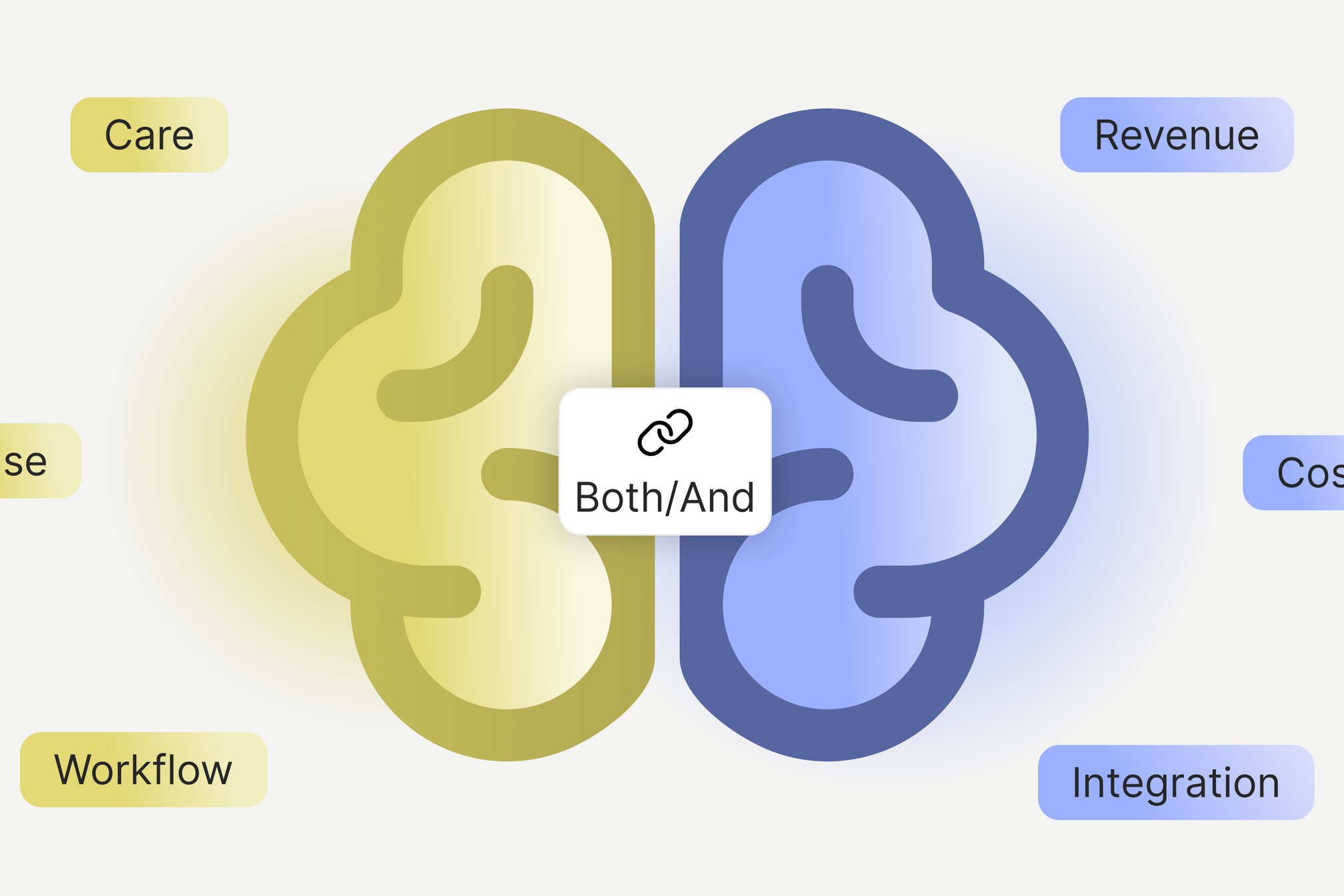
Think of your practice as two brains with two distinct perspectives. The clinical brain focuses on patient care, workflow, and documentation. The business brain focuses on revenue, analytics, and sustainability. Most technology failures happen because practices make decisions using only one brain at a time.
Ernie learned this through expensive mistakes. When he chose systems alone, therapists hated them or costs spiraled. When therapists chose alone, critical billing functions broke. "We've still probably not gotten about 80% of that money," he says about one payment redirection disaster that came from a hidden setting that redirected insurance payments to patients instead of the practice.
The Clinical Brain Evaluates:
Debbie represents the clinical brain. She asks: Can I actually use this while seeing 8-12 patients back-to-back daily?
Her evaluation approach is straightforward. "I like when it's intuitive,” she says. “If I can look at it and I can click and find the thing that I'm looking for, great."
She considers things like:
- Can I write notes my way and easily communicate what I mean?
- Does the scheduling system show my patients clearly without hunting through menus?
- Will the system alert me when re-evaluations are due or plans of care expire?
The clinical brain doesn't care about dashboards or analytics. It cares about whether the system supports or disrupts the actual therapy work. "I like writing my reports, I like doing my things my way," Debbie says.
What she’s building is protection of clinical quality. When technology systems break therapist workflows, patient care suffers.
The Business Brain Evaluates:
Ernie represents the business brain. He asks: Will this help us grow while staying financially viable?
His tests veer in a different direction:
- Can the system accurately submit and scrub claims across multiple payers?
- What's the true three-year cost, including hidden fees for specific features we might need?
- Does it provide reporting and analytics to identify scheduling gaps and revenue patterns?
- Can it handle the specific nuances of our practice (parent-child relationships, split billing, etc.)?
The business brain sees beyond the demo. It pressure-tests edge cases: "Everything happens once, but it never happens twice," Ernie observes. The system needs flexibility for scenarios that arise once and never repeat exactly the same way.
Engaging Both Brains: The Integration Protocol
After several one-sided decisions failing, Ernie developed a process: "We took 4 or 5 months, and had therapists sit in and ask the questions. I didn't want to choose the system alone."
Here's how to activate both brains:
- Month 1-2: Clinical brain evaluates core workflows. Can therapists actually schedule, document, and complete daily tasks? If this fails, stop.
- Month 2-3: Business brain tests billing, reporting, and cost models. Don't just verify features exist—run real scenarios through the system.
- Month 3-4: Both brains examine integration. What workarounds will you need? "We've built all these little pieces of technology around the EMR," Ernie notes. "Spreadsheets for this, or a database for this." Start planning these bridges before committing.
- Month 4-5: Trial period with both perspectives monitoring. Therapists report on daily usability. Business operators track whether claims process correctly and data flows as needed.
The system must pass both brains' tests. Single-sided decisions create half-functional solutions that fail when it matters most.
"If our therapists are unhappy in terms of what they have to do, nothing else even matters, because you won't have claims to submit," Ernie explains. But the reverse is equally true: if the business side can't access the intelligence it needs, the practice can't sustain operations.
Use both brains. Every time.
The both/and practice
A lot of practices assume that what's good for therapists or patients costs the business, and what's good for the business burdens therapists or comes at the expense of patient care.
But you don’t have to choose between profits and patient care, and strong technology decisions can help.
"Technology could increase the data we can collect to help the kids we work with achieve better outcomes and increase collaboration across the disciplines," Ernie observes.
Consider documentation. Better clinical notes improve care and justify higher reimbursements. When automation reduces the time therapists spend writing daily notes, practices gain scheduling flexibility while therapists experience less burnout.
"If we could make the lives easier for clinicians, maybe we can keep them from becoming stressed out and burned out," Ernie suggests. And clinicians who are less stressed are able to better serve their patients.
Debbie appreciates systems that tell her "how many notes are written based on how many kids were checked in, time in, time out" because it helps with documentation. That same functionality gives Ernie the productivity metrics he needs to understand capacity and identify scheduling gaps.
When therapists have better tools that remove key points of friction, patients receive effective care and the business grows.
Little Land runs on multiple technology platforms because no single solution meets all their needs. "All of our staff have to learn two distinctly different systems to do two different processes," Ernie notes. They've built workarounds—spreadsheets, databases, bridge tools—that connect the pieces. It's not elegant. It's not what Ernie envisioned when he started testing systems a decade ago.
Yet it works because they understand the priority: patient care (and those who provide it) come first, business intelligence comes second, and both matter deeply.
"We have to do both at the same time," Ernie says as a reminder when describing the tension between helping kids and running a sustainable business.
Every practice has this tension.
The thriving practices have learned to leverage what others see as conflict.