
Thursday, July 30, 2026
The Reliability Matrix: Where to Trust AI in Your Practice
Imagine this scenario: Two AI agents are running in a practice. One reschedules existing patients and fills cancellations off the waitlist. The other sits on the phone with new patients, answering questions about the practice.
AI can generally do both. But one agent in this instance is reliably saving the front desk an hour a day, while the other could be losing patients before they ever walk in the door.
That's what the question, "Can AI do this?" completely misses. It might perform adequately in a demo, but getting it to run predictably with good outputs in another challenge. AI isn't one capability you either have or don't. It runs inside workflows, and every workflow carries its own level of risk.
Flattening this line of reasoning into a yes or no, fails to surface considerations around workflow and the risk if something goes wrong.
Sorting that out is exactly the problem Co-founder and CEO of Indie Health Eddie Czech and his team have solved. Across the practices they work with, he says, "One of the first things we hear about AI is … I want to use it. I want to invest in it, but I don't know where to get started."
The answer isn't a yes-or-no verdict. It's a logical way to interrogate any workflow and decide whether AI belongs in it.
Key Takeaways:
- The right question isn’t “Can AI do this?” It’s “How reliable is AI in this scenario, and is the level of risk if something goes wrong tolerable?"
- AI reliability sorts into three tiers: high (predictable inputs, low cost if wrong), mixed (keep a human in the loop), and low (keep AI out for now).
- Start where you already have a documented, repeatable process. The technology is only as good as the inputs you give it.
Where AI Works Today
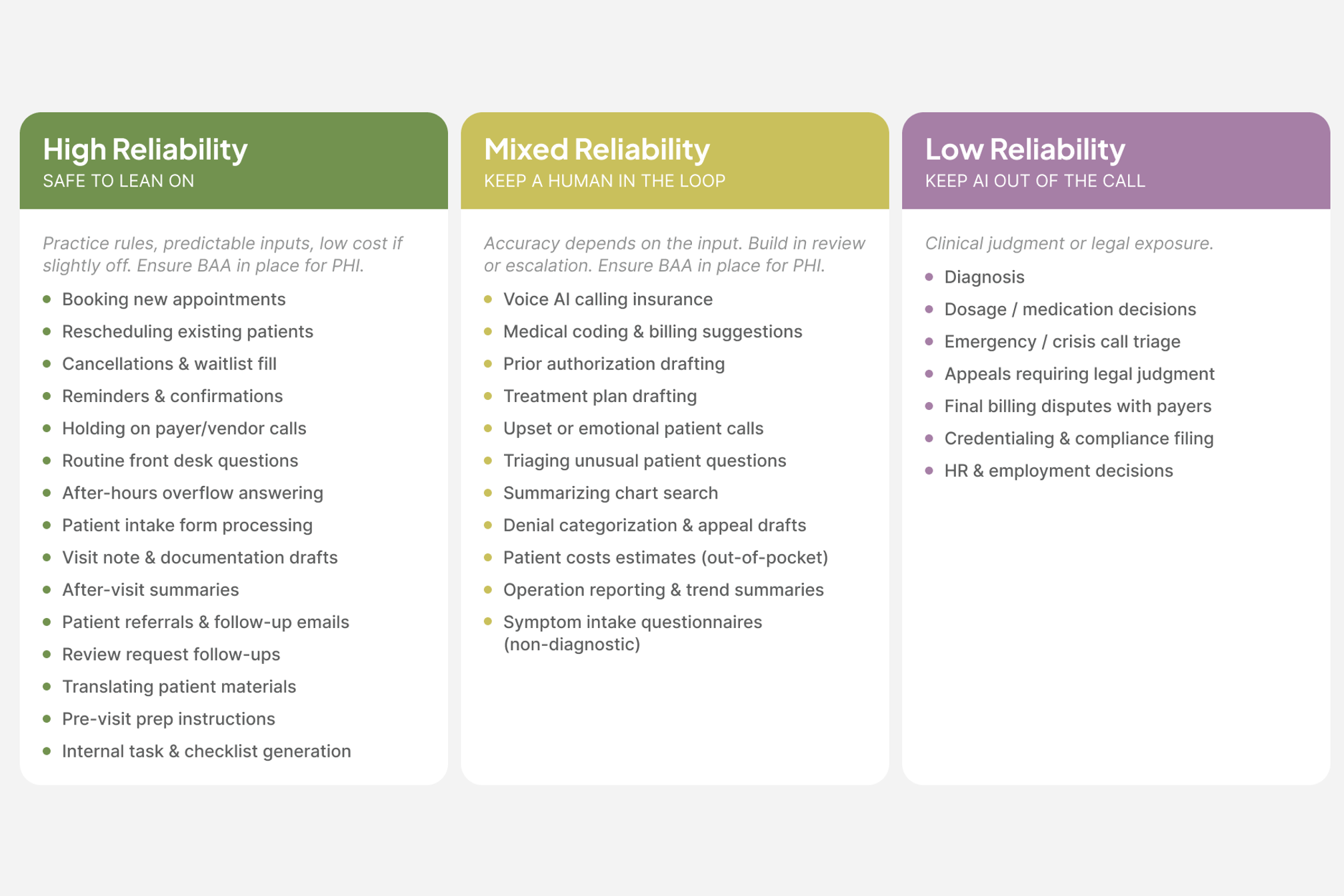
Let’s start with the lay of the land. Across most practices, workflows land in three tiers based on how much you can rely on AI to run them. Treat this as a snapshot, not a rulebook; the value is the pattern underneath it.
High reliability: Safe to lean on AI
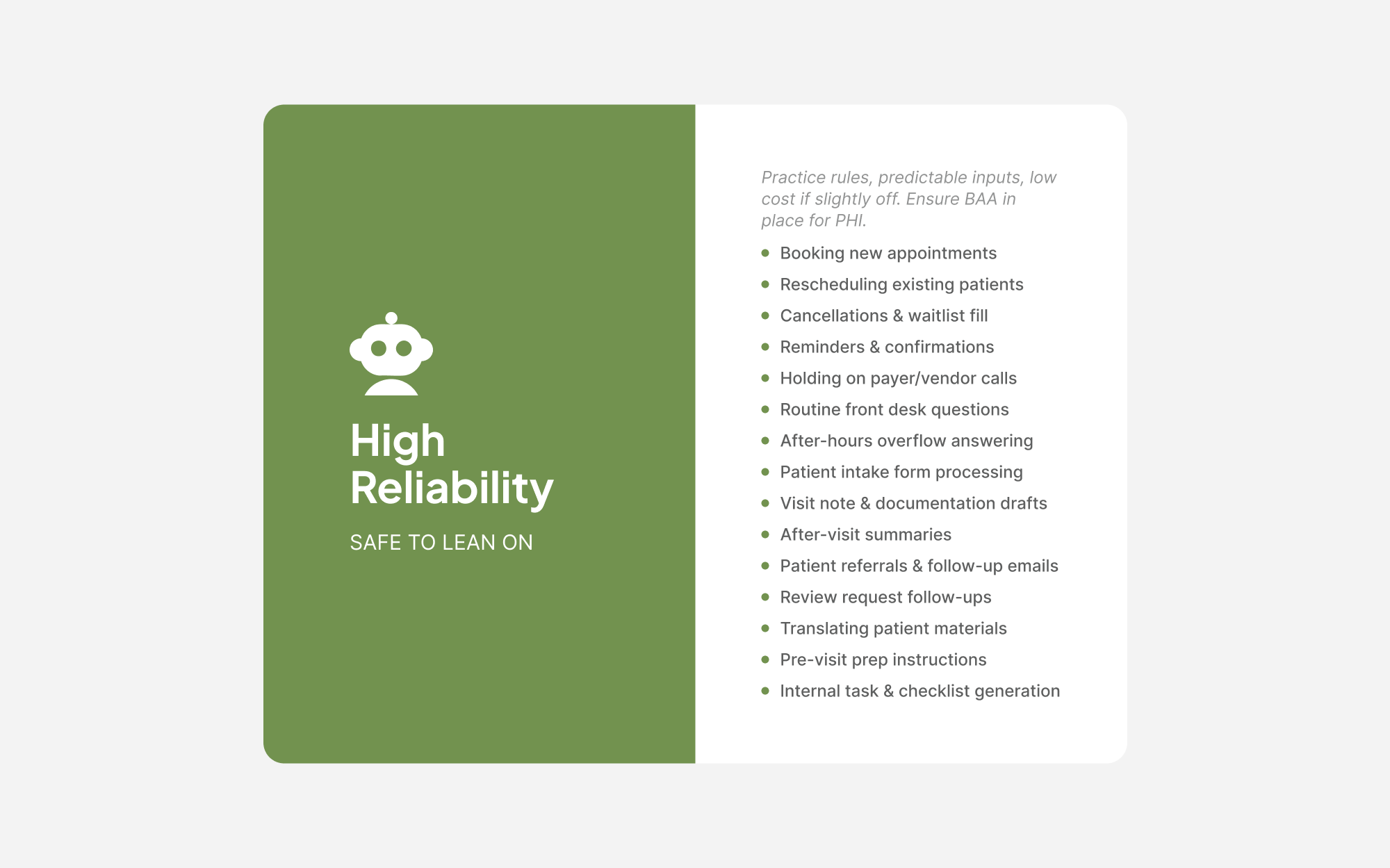
These are workflows with clear rules, predictable inputs, and little cost if something slips, but low stakes doesn't mean low value.
Take the waitlist. Eddie works with clinics with high rates of cancellations, and every unfilled slot is money left on the table. An AI tool can text or call existing patients on the waitlist and backfill the openings before the morning even starts.
Practice owners are also all too familiar with the hours staff sits on hold with payers. Eddie says an agent can instead sit on the line and hand off to a person only once the insurance company picks up. "On an hourly basis, you're paying a fraction of what you would pay a human to sit and wait on hold," he says.
Translation is another quiet win. When the bilingual staffer covering your Spanish- or Polish-speaking patients leaves, continuity of patient experience tends to walk out with them, and the voice models are now good enough to hold that line.
Mixed reliability: Keep a human in the loop
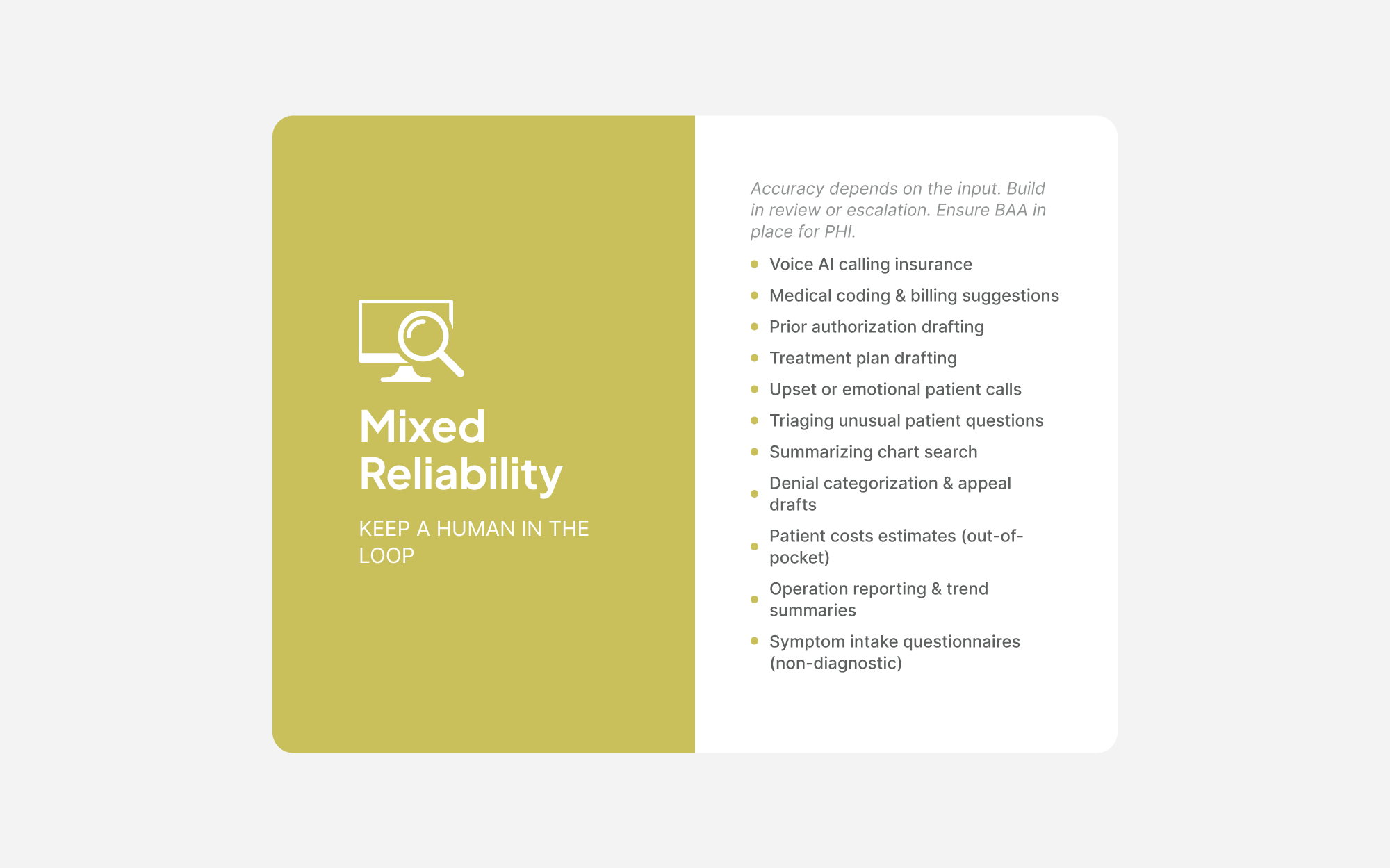
In these applications, the output rides on the input, so you build in review or escalation before anything reaches a patient.
"Accuracy largely depends on the input," Eddie says. Phone calls are the classic case. A voice agent can field routine questions, but the moment a caller needs more in-depth discussion on your practice’s benefits or has an issue that needs to be resolved, you might want to consider having the agent hand it off to a front-desk staffer.
Treatment plans fit the same draft-then-review pattern. If a patient comes in with a Grade 1 hamstring strain, there's already a protocol for that recovery, so you could feed their records and context into the system, have it generate a first-draft plan of care, and put a clinician on the final read. In this instance, the AI does the legwork, but the human owns the final call and implementation. Note, this application could implicate PHI, and a BAA with any third party vendors is critical to ensure compliance.
Eddie describes how Indie Health keeps humans in the loop to adapt to each practice’s risk tolerance. For some customers, who might be earlier in their AI adoption journey, he says, when a voice agent schedules a new appointment, it doesn't actually complete the booking. Instead, it opens a task for a person to review and accept first. This sequence is particularly valuable for any new patients that might require additional intake.
Low reliability: No AI, for now
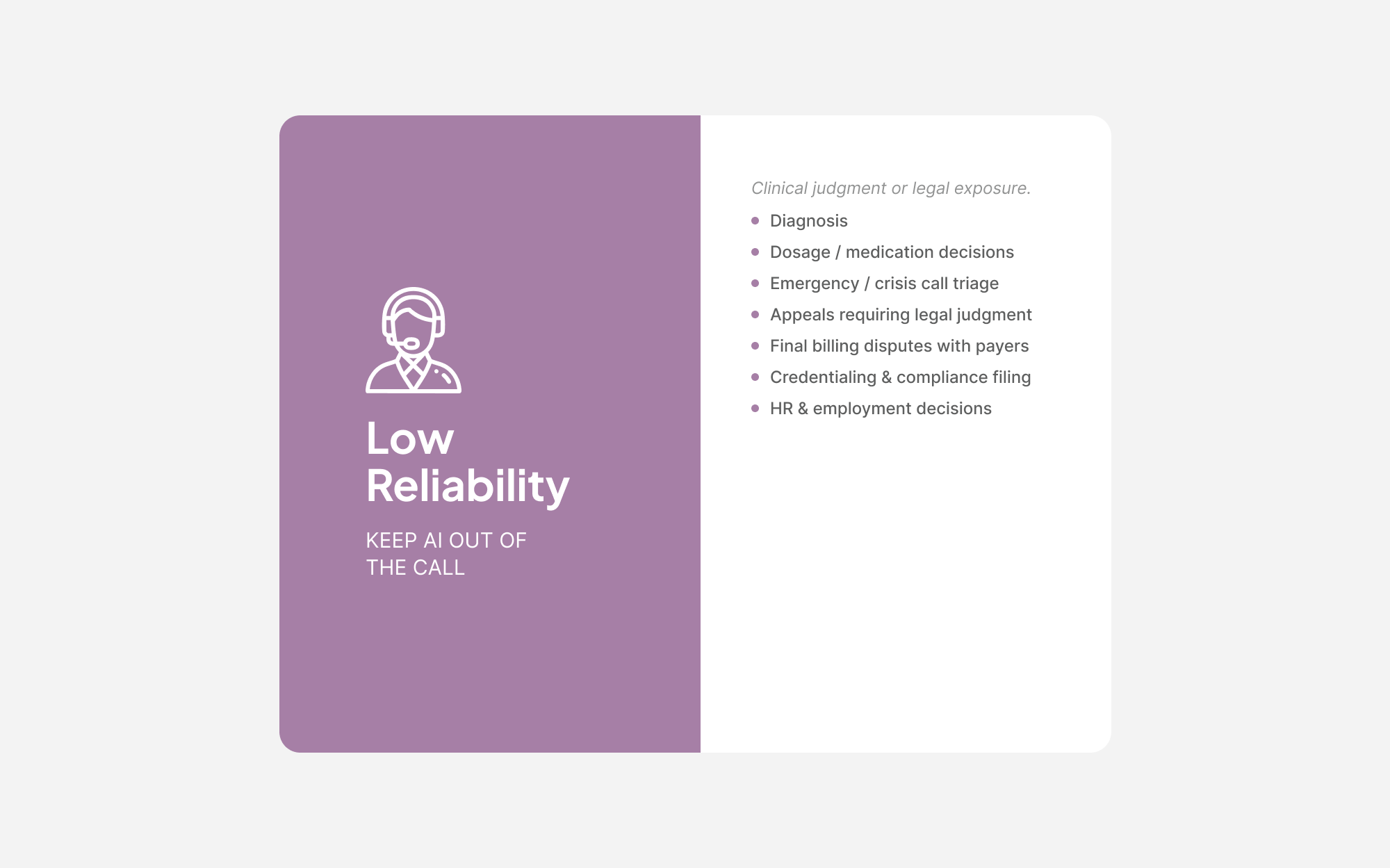
This is the end of the spectrum where a mistake can't be walked back. Misclassify a fax and it's an internal hiccup. Diagnosis is the opposite: "Using AI to diagnose a patient, there's a lot of risk if that goes wrong," Eddie says. The same caution covers final treatment and medication calls, emergency triage, and anything with real clinical or legal exposure.
The deciding question isn't whether AI could technically attempt the task — it's what risk level is tolerable. And the tell isn't always the task; sometimes it's your own documentation. If you can't describe how you do the work today, you can't hand it off yet. “When some practices will come to us and say, 'We don't really know what we're doing on this workflow. Can AI do this?' That's a really bad place to start," Eddie cautions.
How to Sort Any Workflow Yourself
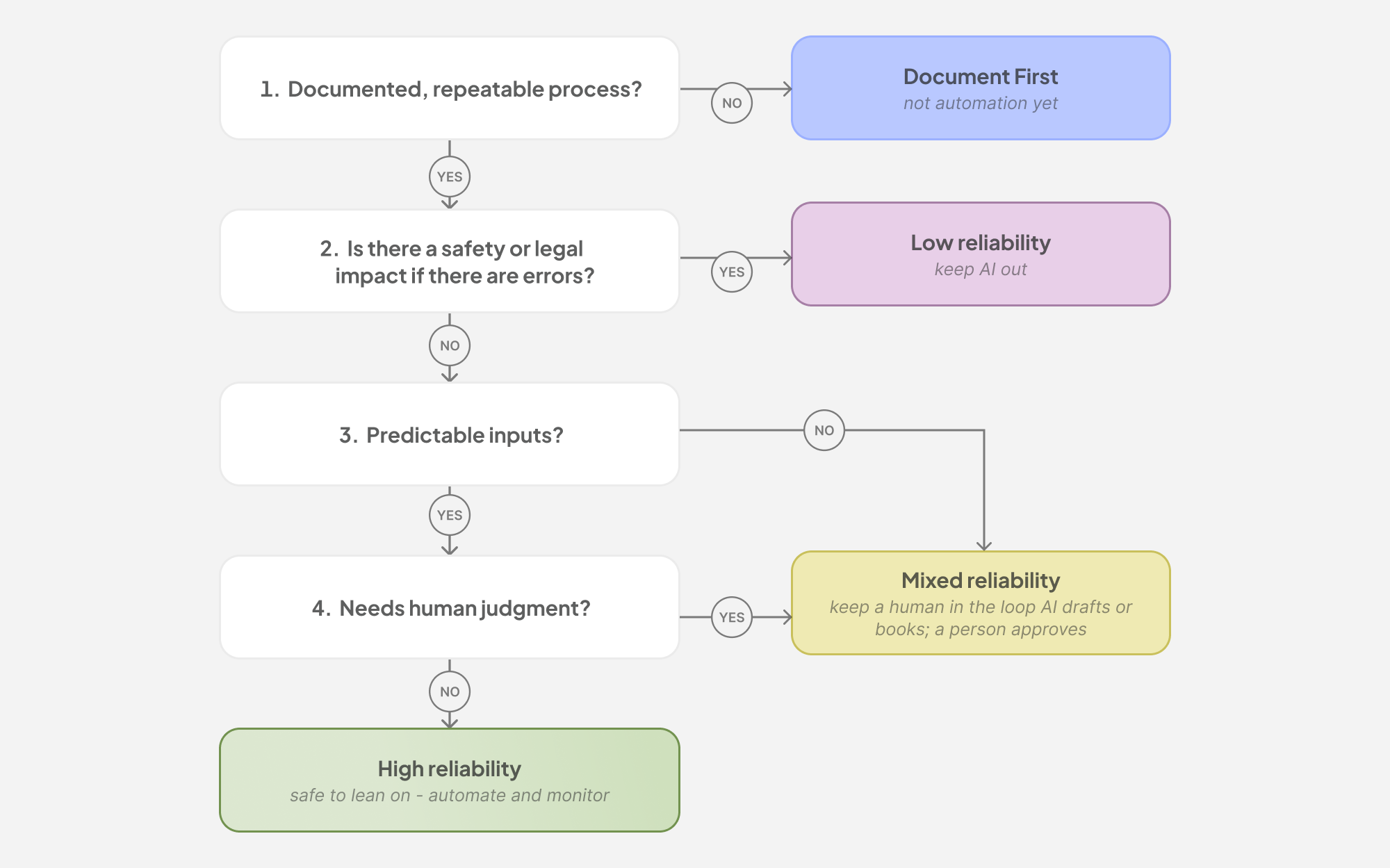
The tiers above are examples of where the technology stands today, but it is an ever-evolving landscape. The skill worth having is being able determine yourself if AI is fit for purpose. Run the workflow through four questions:
- Is there a documented, repeatable process? If you can’t say how you do it today, that’s the first project, not the automation.
- What’s the cost if it gets it wrong? Internal and easily caught, patient experience or revenue, or patient safety and legal exposure?
- How predictable are the inputs? The same kind of information every time, or messy and variable?
- Does it require human judgement, and if so, can you put a review or escalation in front of anything final? A clinical or legal call, real empathy, or a sell. The agent drafts or books; a person approves before it’s real.
The answers sort according to the reliability matrix tiers shared above. Documented, predictable, low-cost, and no judgment needed is high reliability — automate and monitor. Variable inputs, real cost, or a human touch, but with a review step you can add, is mixed — let AI draft or front-line while a person approves or takes over. Clinical or legal exposure that review can’t de-risk stays low — keep AI out of the decision for now.
How to Actually Get Started
Everything downstream depends on one thing: how well you've defined the process you're handing over. "The accuracy of these systems is largely dependent on the input," Eddie says, and "the input in a lot of these cases is the documentation or process or protocol that you already have in place."
The practices that struggle are the ones hoping AI will create order they never built; the ones that succeed already have it and just want to run it more efficiently. So start where your process is clearest, and if the documentation is thin, that's the first project. AI can even help you build it. Talk a workflow out loud and have an LLM draft the SOP, or interview the handful of people involved and let it synthesize their accounts into one clean document.
You also don't need a vendor to begin. "Some of the non-clinical or patient work you could just solve with ChatGPT or Claude," Eddie suggests. The practices that build real fluency make it a habit rather than an option. “A growing number of practices have a mandate that people need to use the tools," he adds. Some practices even run informal demo days where staff show off what they pulled together that week. These are low-stakes habits, and it builds muscle before any vendor is on the table.
Whatever you choose, resist doing everything at once. The most common failure Eddie sees is operators who "overcomplicate things up front." Take a crawl, walk, run approach — one high-leverage, low-risk task that saves someone a few minutes, repeated thirty or forty times a day, compounds quickly and shows the team it works. By the time you're finally across the table from a vendor, you'll be evaluating them from a position of experience.
A Map of What to Hand Off, Not What to Cut
Read the matrix left to right and a pattern shows up: Nobody wants to be a robot. They don't want to do repetitive, low-value tasks. They want to deliver an amazing patient experience that leads to improved care and outcomes, whether you're an admin or a clinician. Sitting on hold with a payer. Sorting inbound faxes. Confirming the same appointment, again. Handing that off redirects your team toward higher-impact work.
Now, look at what stays in the human column: the prospective patient asking why you’re better than the clinic down the street, the upset caller who needs a person, the clinician signing off on a treatment plan. That’s higher-judgment, higher-value work, and it’s exactly where an experienced staffer is worth every dollar.
The reliability matrix isn’t a list of jobs to cut. It’s a map of what to hand off, so your people spend their day on the calls and decisions that actually need them.
Frequently Asked Questions
How do I know which tier a workflow belongs in?
Run it through four questions: Is there a documented, repeatable process? What's the cost if it's wrong? How predictable are the inputs? And does it take human judgment — and if so, can you put a review or escalation in front of anything final?
Predictable inputs, low cost, and no judgment needed is high reliability, safe to lean on. Variable inputs, real cost, or a human touch you can wrap in a review step is mixed — keep a person in the loop. Clinical or legal exposure that review can't de-risk stays low. The deciding factor isn't whether AI perform the task in a demo; it's how reliable it is in practice and how much risk is acceptable if something goes wrong.
What if our processes aren't documented?
That's your first project, not your vendor's. These systems are only as good as their inputs, and the input is the process you already have in place. The upside is AI can help you build the documentation. Talk a workflow out loud and have an LLM draft the SOP, or interview the handful of people involved and have it synthesize their accounts into one clean document.
Do I need a vendor to start implementing AI tools?
No. A lot of what you'd want to automate you can start on your own with off-the-shelf tools. For anything touching patient information, anonymize it first or put a BAA in place. Getting fluent this way means that when you do sit down with a vendor, you're judging the tool from experience.
Is this going to replace my staff?
No. It changes what they spend the day on. Handing the predictable, low-stakes work (payer holds, inbound faxes, routine confirmations) to AI pulls your most experienced people onto the tasks that need a human: the upset caller, the prospective patient weighing you against the clinic down the street, the clinician signing off on a treatment plan. It's a map of what to hand off, not a list of jobs to cut.