
Thursday, February 26, 2026
How One PT Owner Found 8% Growth in His Existing Caseload


A four-week workflow that prevents mid-treatment drop-off and maximizes existing patient relationships
Ben Carlson runs a second-generation physical therapy practice entering its 38th year across five Connecticut locations. When Ben analyzed his 2024 revenue data through Prompt EMR, he found the practice grew 8% year-over-year despite seeing only five initial evaluations.
But this wasn’t an accident.
Ben had spent much of the year focused on comprehensive practice renovations like modernizing clinics, unifying branding across locations, and upgrading facilities with new equipment and updated layouts. New patient acquisition took a back seat.
Yet the practice still grew significantly because Ben was also focused on getting patients through complete care cycles instead of losing them mid-treatment.
Practices pour money into acquiring new patients while quietly losing thousands in revenue from patients who drop off before finishing their entire treatment plan. Instead of fixing the funnel, what if you could fix the leak?
Key Takeaways:
- Specificity prevents workflow failure: "Every third week" succeeds where "focus more on retention" fails every time
- Building desired behaviors into the calendar eliminates the need for willpower-based change
- Framing mid-care reviews as clinical assessment rather than retention pitch prevents provider resistance and maintains care quality
- Most practices have 10% growth available through experience optimization before spending another dollar on new patient acquisition
The Patient Disappearing Act Happening Between Visits 4 and 7
Ben found that patients stopped scheduling somewhere between their fourth and seventh visits.
“We see fall off because it’s easy for care to start to get stale around that time,” Ben says.
Providers get caught in cycles of "treat and treat and treat." They're busy delivering care but rarely step back to comprehensively reassess cases. On top of that, week-to-week improvements become incremental. Patients start to feel like their progress is crawling instead of seeing the massive gains they likely experienced initially.
Without intentional touchpoints, patients drift away before completing their full treatment plan.
“But we want to encourage them to get that full discharge and receive their entire treatment,” Ben explains.
When patients cancel, front desk staff try to fill gaps with new appointments. But the real opportunity sits with the patients who already started treatment, keeping them engaged instead of constantly replacing lost revenue with new acquisition.
The practice needed a proactive system that caught patients before they stopped scheduling.
Building Re-Enrollment Into the Calendar
All it took was a simple calendar trigger.
Ben borrowed the concept of "re-enrollment week" from Rehab CEOs and adapted it for his practice. Rather than leaving providers to independently build case reviews into their schedules whenever possible, every third week of the month becomes dedicated re-enrollment time for all active patients.His implementation followed four steps that any practice can replicate.
Identify the Drop-Off Window
Before implementing any workflow changes, Ben needed visibility into exactly where patients were falling off in their care cycles. Through Prompt EMR's plan of care tracking and reporting features, he identified patterns showing that the 4-7 visit range was the critical drop-off window.
The practice reviewed historical data to confirm that this mid-treatment disengagement was consistent across providers and locations, meaning they needed a systematic solution.
Build the Calendar Trigger
"What works for us is every third week of the month,” Ben explains. “The leadership team sends out a message and says, ‘Hey, team, remember, it's re-enrollment week.’ "
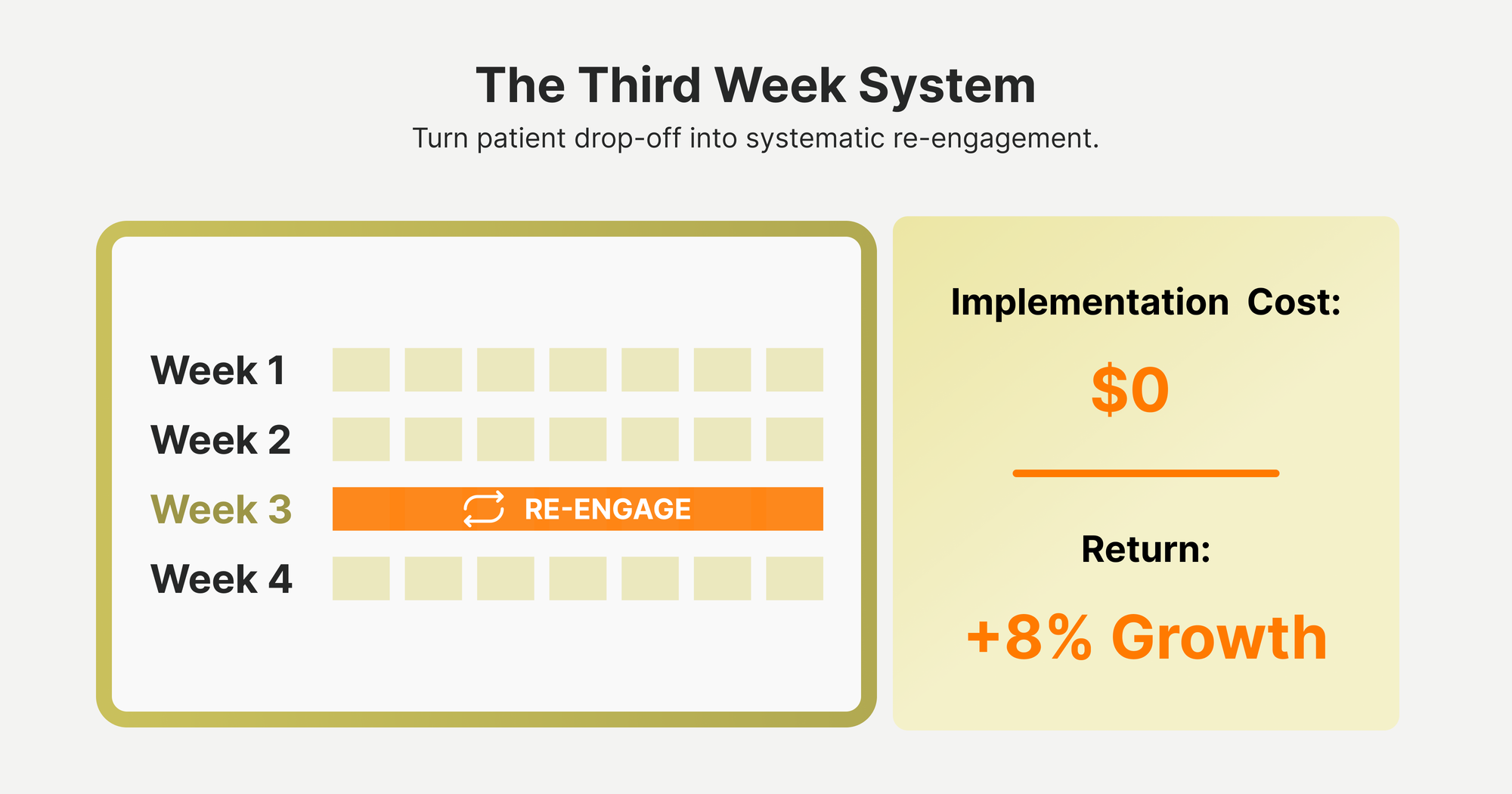
The monthly cadence creates a systemic safety net. For Ben’s practice, the third week trigger is positioned perfectly to reach the majority of patients around the typical drop-off point.To find the right timing for your practice, start by reviewing your EMR data to identify when patients typically disengage. Match your re-enrollment cadence to catch patients just before they historically drop off.
Make It Clinical, Not Transactional
Ben emphasized to his team that re-enrollment week wasn't about convincing patients to book more visits. The goal is to ensure patients receive complete, clinically appropriate care.
Providers conduct a thorough mid-care case review similar to the comprehensive initial evaluation, reassessing progress, recalibrating expectations, and reconnecting patient goals to treatment outcomes.
This framing empowers providers to use their clinical expertise rather than following a scripted retention conversation. The focus stays on what's clinically appropriate for each patient, not what's best for the schedule.
Create Team-Wide Accountability
First, analyze the data. Then align leadership. Establish your clinical framing. Finally, make sure your entire team acts on the "re-enrollment week" reminder. Otherwise, all you've done is built a calendar entry instead of a functioning system.
The specificity of the workflow, especially in terms of its regular recurrence, prevents it from becoming vague advice that simply gets ignored. Instead of just saying, “We need to get better at patient retention,” the practice now has a concrete process with tactical steps clinicians can follow to do just that.
Initial evaluations only get patients started with treatment. Mid-care reviews keep them committed through completion.
The 10% Most Practices Already Have
"I can guarantee that most practice owners have at least a 10% delta if they just work on improving the experience of what they’ve already got," Ben says.
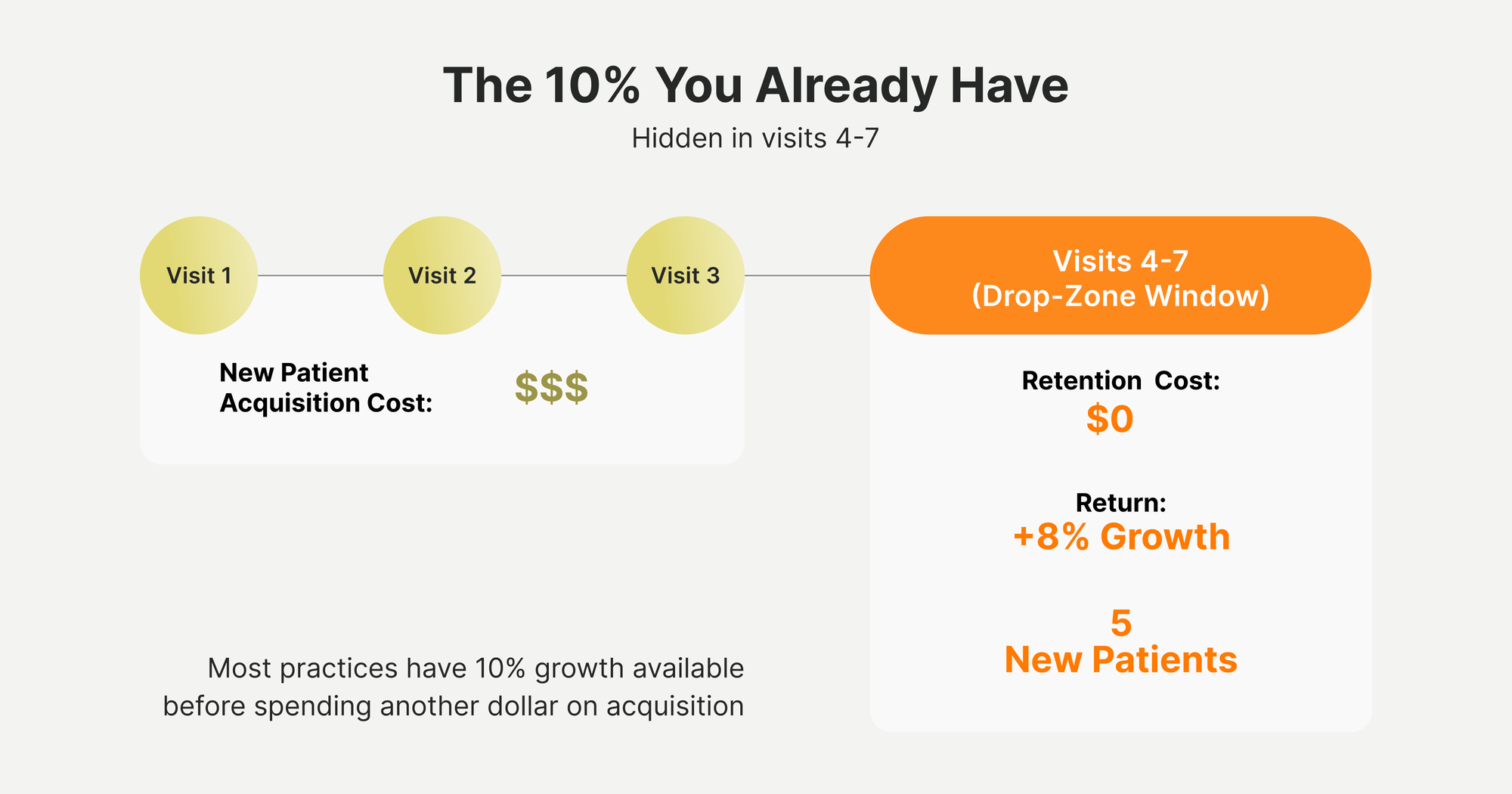
That 10% isn't hiding in marketing campaigns or new patient funnels. It's sitting in your existing schedule with the patients who start treatment but don't finish.
Most practices operate under the flawed assumption that growth requires more new patients. So they pour resources into acquisition while revenue leaks out through incomplete care cycles. But the math actually favors retention.
Ben’s practice saw their 8% growth almost entirely from keeping current patients engaged.
Guiding an existing patient through complete treatment costs nothing compared to acquiring a new one. That patient already trusts you. They've already committed to starting care. You just need systematic touchpoints to prevent them from drifting away.
This is where technology and workflow must come together. EMR automation can identify which patients are falling off their treatment plan, but that data only creates value when paired with clear processes, like re-enrollment week, that tell your team exactly when and how to act on it.
An intentional workflow turns alerts that threaten to overwhelm your staff into a strong foundation for proactive care that improves both patient outcomes and practice performance.
The calendar reminder becomes a guardrail. Providers do the clinical work. Together, they keep patients on track.
For practices struggling with retention, the path forward comes from building systematic touchpoints that maximize the relationships you've already invested in creating.
Frequently Asked Questions
How much does implementing a patient retention system cost for small PT practices?
Implementing a calendar-based retention system like Ben Carlson's re-enrollment week costs nothing. The system requires no additional software beyond your existing EMR's plan of care tracking features. Implementation takes approximately two weeks and relies on building structured touchpoints into your existing calendar rather than purchasing new technology.
Most practices find this approach more cost-effective than increasing marketing spend for new patient acquisition, especially since guiding existing patients through complete treatment cycles generates revenue without acquisition costs.
What causes physical therapy patients to drop off in their care plans?
Patients typically disengage from physical therapy treatment because progress becomes incremental rather than dramatic. Early treatment produces visible improvements—patients might see 40% gains in mobility or pain reduction in their first few visits. But then week-to-week improvements start to shrink. Treatment starts feeling routine.
Without structured touchpoints to reconnect patients to their original goals and reassess progress, motivation wanes and patients simply stop scheduling appointments before completing their full treatment plan.
How can PT practices improve patient retention without making providers feel like salespeople?
Frame mid-care touchpoints as clinical assessment rather than retention conversations. Ben Carlson's approach positions re-enrollment week as a comprehensive case review similar to initial evaluations: providers reassess where patients started, evaluate current progress, and recalibrate treatment plans using their clinical judgment. This framing prevents provider resistance because clinicians use their expertise rather than following scripted sales pitches.