
Monday, August 24, 2026
Stop Selling Clinical Information. You Already Lost That Business.


Here's the uncomfortable premise every independent operator needs to sit with: the clinical information your clinicians spent a decade learning is now free. A patient can open an AI tool, describe their symptoms, and walk away with a structured exercise program in under a minute.
Michael Lau, Co-Founder and CEO of [P]rehab (@theprehabguys) and [P]rehab Physical Therapy, has watched this happen from both sides. In addition to running a clinic, he shares tons of free content on physical therapy education through his Instagram and YouTube. His read isn't alarm. It's that the free program was never the thing patients were buying.
"You can go on AI right now and you could probably put in your symptoms," he says, "and I guarantee they will give you a program." Then, the observation that matters: Patients need to decide if they trust the output.
This problem isn’t unique to free content, and it isn’t necessarily about accuracy. "Even when someone comes into PT and the PT evaluates them and gives them a program, there are still a handful of patients that don't trust what that PT gives them."
If in-person clinical authority doesn't automatically produce trust, then trust is the product, and it has to be earned by something other than simply being right. “Trust is everything... especially when you're in pain," he adds.
The counterintuitive operational move that builds trust fastest is the one most practices can't bring themselves to make: Turn away patients you can't genuinely help.
Key Takeaways:
- Clinical information is now free. The defensible product is trust.
- A refer-out has to be a documented protocol with a named destination, or it won't survive contact with a schedule that needs filling.
- Therapists need to see themselves as coaches rather than visit-fillers to execute this approach.
Referring Out Is a Growth Move, Not a Leak

Most operators treat every patient on the schedule as revenue and every referral out as loss. Lau doesn't, and he's made it policy. When he onboarded a new PT, the first thing he told her was that "if someone's not appropriate, we don't see them." The revenue doesn't change the answer — "I don't care if they want to see us, they're going to pay us, we refer out" — because "I want to get that person the best possible care."
Notice what's hard about that. The money is sitting in front of him and the answer is still no. What he gets back is a patient who can see that "we ultimately want the best result for that patient."
Filter for the patients you can genuinely help and that group stays longer, adheres better, refers more, and produces the outcomes your reputation runs on. You trade a full-but-fragile schedule for a smaller, more durable one.
Lau sees this as a problem that transcends any individual practice, running through the reputation of the entire profession. When a patient's only experience of physical therapy is a mill, they don't blame the clinic. They blame the treatment. "You're just getting heat packs and Stim and you're only being seen for 15 minutes," he says. And what they take away from it is "PT doesn't work. PT sucks. That's the image of PT in most people's brain."
His read on why that image persists is structural. Those businesses are doing the thing their economics allow: "The only way for those businesses to survive is to see more clients, or do those modalities, because that's what CMS will pay for — they'll pay for the heat pack." And the frustrating part: "They won't actually pay for the education and sitting down with the patient and really trying to understand what's happening." So the volume-first model manufactures the bad outcomes that poison the category for everyone in it, including you.
Which is also why this can't just be a value you hold. Lau's clinic is a single cash-pay location, so referring out costs him one patient. At six locations with productivity targets, a bonus structure tied to visits, and a director who has to explain a soft month, it costs considerably more. A value gets overridden by a Tuesday with gaps in the schedule. A protocol with named criteria and a named destination doesn't.
How to Build the Protocol
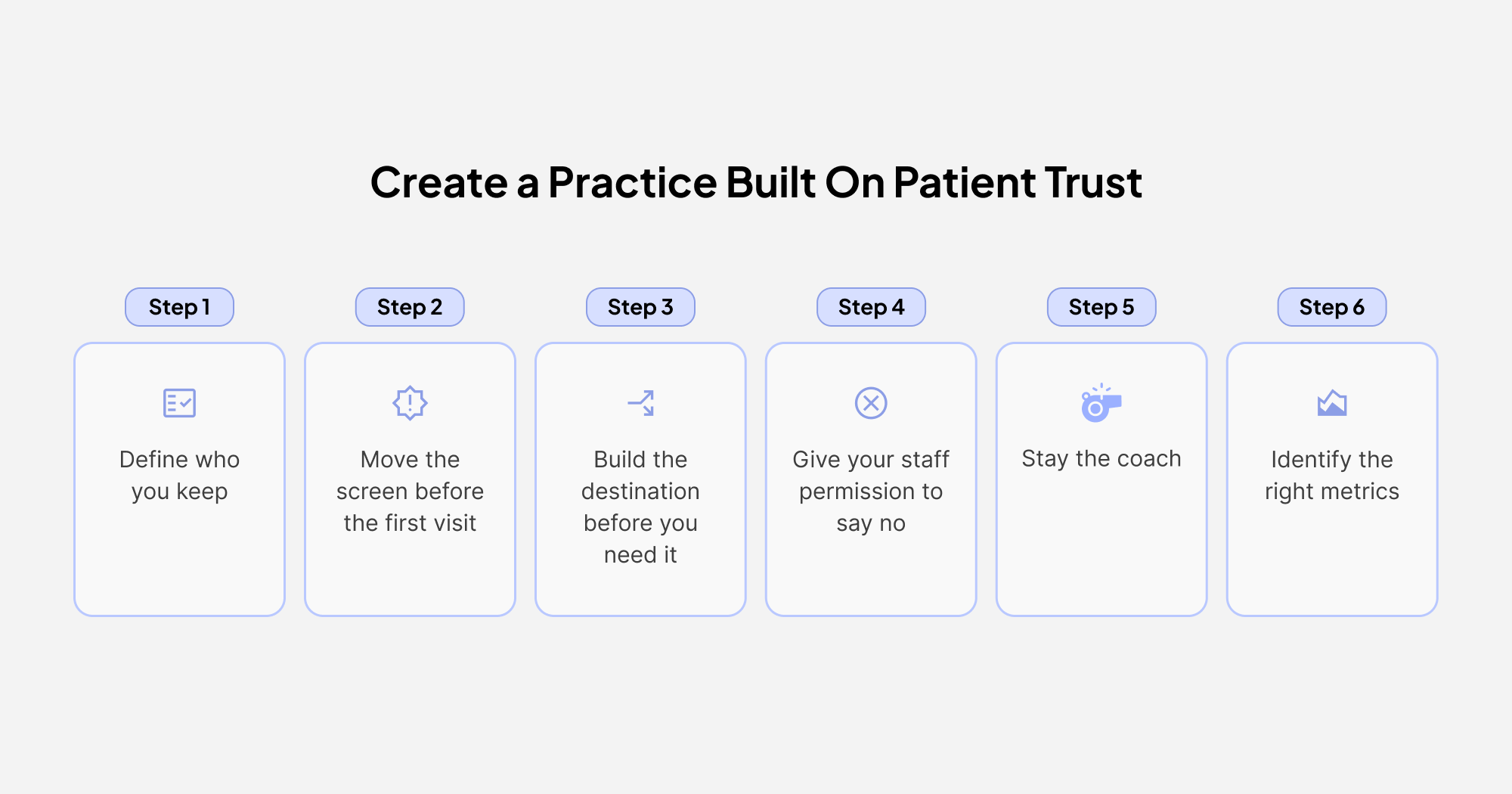
Step 1: Define who you keep
Before you can identify who to refer out, define who you're for. Which conditions do your clinicians treat exceptionally well? Which patient goals fit your model? Which acuity levels, comorbidities, and red flags sit outside your scope?
Write these as concrete criteria, not principles. Your protocol is only as good as the clarity of that definition, and a generic "we help people move better" screens nobody out.
Step 2: Move the screen before the first visit
The screen belongs at intake — on the phone or in the intake form review — not in the evaluation. Once a patient is on the schedule and in the room, the cost of the honest conversation goes up for everyone.
The screen answers one question: Is this someone we can genuinely help? If the answer is no, the protocol triggers a referral, not a booking.
This is also where technology earns its place. Structured intake that captures the right information on the first call, and routing that flags the cases outside your criteria, means your staff isn't making a clinical judgment on the fly. The tooling surfaces the decision; a person still makes it.
Step 3: Build the destination before you need it
You cannot credibly refer someone without first building your network of orthopedists, surgeons, pain physicians, hand specialists, pelvic health clinics, and neighboring practices you would send your own family to. Name them, keep the list current per market, and make sure every clinic director has it.
A refer-out is only worth as much as the destination. "I'm not the right person for this" builds nothing. "I'm not the right person for this, and Dr. Chen is, and I've already sent her a note" strengthens your authority and enhances trust.
Step 4: Give your staff permission to say no
If your intake staff are measured purely on bookings, they will book everyone and your protocol dies in week one. Give them explicit authority and the actual language: "Based on what you're describing, we may not be the best fit — but let me get you to someone who is. "
Open by restating what they came for. "You told me the goal is getting back to running by spring." That puts the conversation on their outcome, which makes what comes next read as advocacy rather than rejection. Patients can tell a brush-off from genuine care. Say why you're not the fastest path: "The quickest way to get you there is someone who does this specifically, and I know who that is."
Then, make it visible. Track referrals out the way you track referrals in and recognize them in the same meeting where you recognize conversion. A refer-out must be something your team gets credit for, or it will read as a failure to convert no matter what you say.
If staff feel apprehensive, highlight how well positioned they are to execute based on their experience. What's transferable is the thing clinicians do all day — "healthcare practitioners get by far the most reps," meaning the reps of persuading a real person in front of you. Lau’s examples: "convince someone to take that shot that's scared of shots or convince someone to go up and downstairs a certain way, their knee hurts every single time." His verdict: "those are the invaluable skills."
Step 5. Stay the coach
This is the pivot that keeps the relationship with you. You're not disappearing — you're quarterbacking. Tell them to report back and mean it. "Be their coach, be their liaison," as Lau puts it. The patient leaves having gotten something valuable from you, which is the only thing that determines whether they come back or refer someone to your practice.
"What we tell our therapists is you are this person's coach, you are their health coach," Lau says. "Your care doesn't stop when they leave the four walls here."
But none of this survives if clinician identity is tied to a full schedule. If the measure of a good week is visits, referring out is a personal loss. That identity has to be rebuilt first.
Step 6. Identify the right metrics
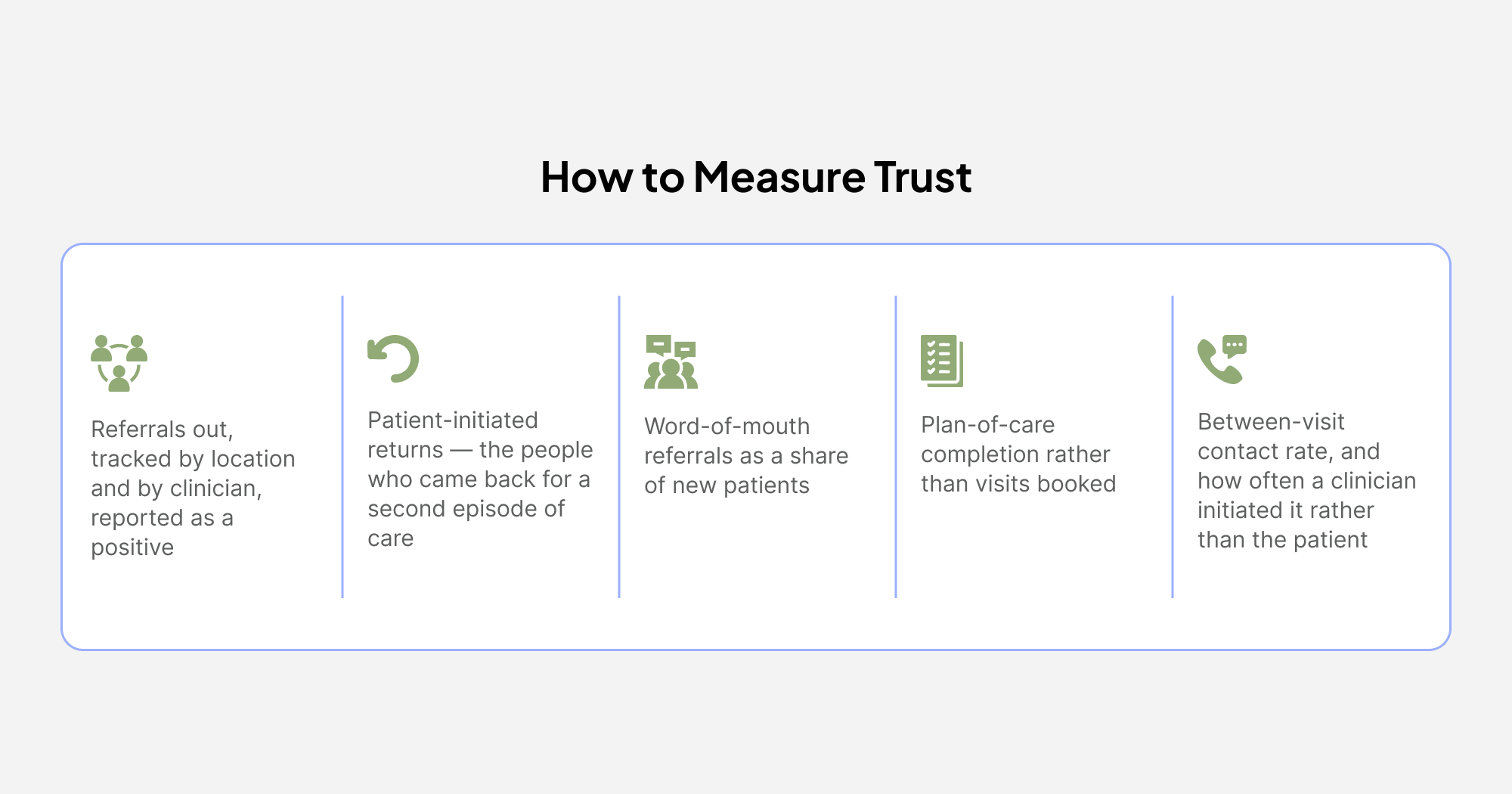
Throughput metrics measure the thing being commoditized. If trust is the product, put numbers on it. While none of these will move in a month, they will compound.
The Bottom Line
Define who you keep, specifically enough to screen someone out. Move that screen to the phone call. Build the referral network before you need it. Give your staff authority to use it, and count what they turn away as a win. Stay in the patient's corner after you've sent them elsewhere. Then, measure returns, word of mouth, and completed plans of care instead of visits.
Start with step one, at one location. The criteria are the hard part; the rest is plumbing. Because a patient can get a program in thirty seconds for free, and they will still sit in your waiting room deciding whether they believe the person handing them one. That's what you're competing on now.
Frequently Asked Questions:
Doesn't referring out just hand revenue to a competitor?
Sometimes, and that's the real cost — worth naming rather than talking around.
What you get back is a patient who saw you be honest when it was expensive to be. That's the most durable referral source there is. And the cost of the alternative is larger: a patient you couldn't help produces a mediocre outcome, and that outcome becomes their story about physical therapy in general, which is the reputational drag the whole profession is already carrying.
How do I stop my staff from booking everyone anyway?
Look at what you measure and what you pay for. If intake performance is booking rate, no amount of training will hold, because you've priced the refer-out as a failure.
Track referrals out as a positive number, review them in the same meeting as conversions, and give your team specific language rather than discretion. Discretion under pressure defaults to booking.
My clinicians' comp is tied to visits. How do I ask them to refer patients away?
You don't, until you fix the arithmetic. A therapist whose bonus depends on volume is being asked to pay personally for the protocol, and that will lose to a soft month every time.
Two things make it survivable. First, move the screen upstream so most refer-outs happen at intake, before a patient ever lands on a clinician's schedule — that keeps the decision away from the person whose number it affects. Second, if productivity is part of comp, exclude protocol-triggered referrals from the calculation, and make sure your directors know that a month with more referrals out isn't a month they have to explain.