
Thursday, January 29, 2026
The Software Disconnect That’s Costing Your Practice


After testing somewhere between 25 and 30 technology platforms over 10 years, Ernie Beltz has earned the right to be skeptical.
His Austin-based practice, Little Land, runs a unique hybrid model: pediatric therapy services alongside family entertainment and education programs. That complexity means he's experienced virtually every way healthcare technology can fail.
Lost revenue for four months due to a payment misdirection bug. Platforms that work perfectly during demos but collapse under real-world workflows. Systems priced for business models his practice doesn't have.
His wife and co-founder, Debbie Garcia-Beltz, brings her own take to the table. As an occupational therapist with 24+ years of clinical experience, she knows what therapists actually need from technology. "I like writing my reports, I like doing my things my way, and making sure it says what I want it to say," she explains.
Together, they've identified the core problem plaguing healthcare technology: developers building solutions for problems they've heard about rather than problems they've lived with.
Key Takeaways:
- Healthcare technology fails because developers design for static scenarios while practices face dynamic, ever-changing operational realities.
- Specialty practices outside the majority market face requirements that general healthcare systems fundamentally can't address.
- AI represents a technology advancement that might actually adapt to practice workflows instead of forcing practices to adapt to rigid systems.
The static solution problem
Software developers often dive into healthcare technology with an engineering mindset: identify the problem, build the solution, ship the product.
That works for problems that stay constant, but in healthcare operations, things are constantly changing.
"You've got software developers building technology to fix a problem they've heard about," Ernie explains. "But without the nuances of running or working in the business, it's really easy to think that things are one static way."
A platform might handle appointment scheduling beautifully—until a clinic needs to account for parent availability, sibling schedules, insurance authorization windows, and equipment conflicts simultaneously.
The system says "this always works this way, this always happens this way." The practice experiences 11 different variations of the same core scenario, each requiring slightly different handling.
"They solve the ‘problem,’ and maybe it can work for one scenario, but it won’t work for the other ways that problem might show up," Ernie notes. "Every scenario or issue that we deal with, you figure out a workaround, and then it never happens again. It'll be slightly different the next time."
This is the fundamental mismatch between how software gets built and how healthcare gets delivered: Developers optimize for repeatability. Healthcare practices manage constant variation.
When your specialty doesn't fit the template
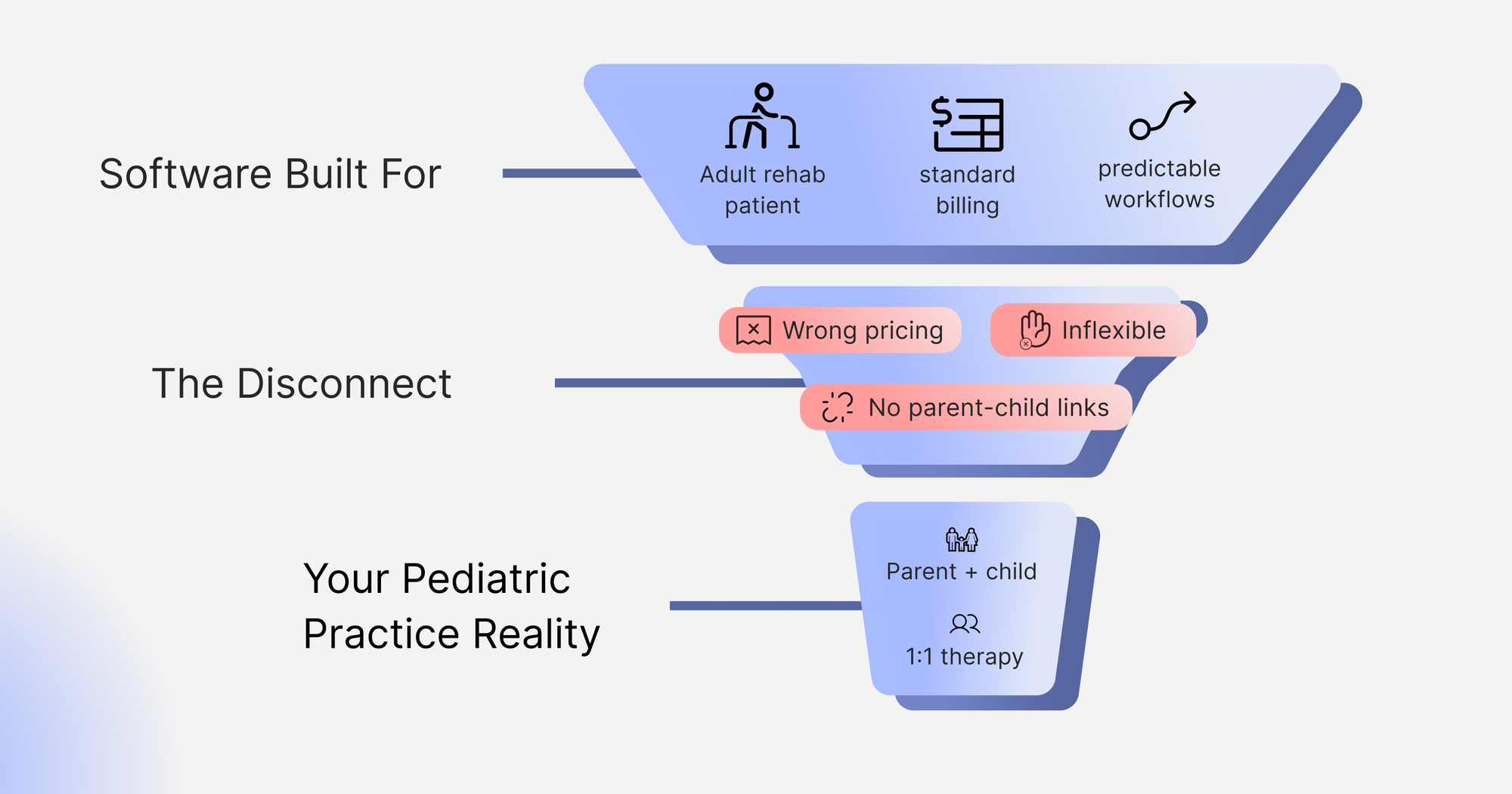
Adult rehabilitation sets the standard for rehab practice technology. Everyone else adapts what gets built for that market.
For Little Land, the economics alone create the problem. Adult PT practices can see multiple patients simultaneously—one on the treadmill, another doing exercises. "Adult rehab has amazing technology that we could use, but it's also priced for adult rehab," Ernie explains. Pediatric therapy operates one-on-one, always. Same hourly rate, completely different revenue model.
The architecture compounds the issue. Most platforms assume the patient is the primary contact. Pediatric practices need parent-child relationships. "We need to know who your parent is, who your guardian is, who's responsible for paying your bills," Ernie explains. That fundamental structure doesn't exist.
Little Land runs two separate platforms as a result. "All of our staff has to learn two distinctly different systems to do two different processes." Pediatric practices are just one case among many in which the technology inherited is built for a different operational reality.
The market is small. The requirements are complex.
The flexibility gap
Even when systems claim to serve pediatric practices, rigidity creates failure points. "A lot of this technology isn't flexible," Ernie observes. "You have to do everything in a tight little box, and you can't do anything else."
Too often, Debbie says, systems bury essential functions behind nested menus and non-obvious pathways. "Click on these three little dots, and then that drop-down will give you this drop-down, and that's when I don't feel like doing this anymore."
Given Little Land's hybrid model, the inflexibility creates compounding problems. "We have no way to analyze our customer value in an easy way," Ernie explains. "We don't have aggregated data about what historical customers have done." The data exists but cannot connect across two distinct systems—creating double reconciliation work, siloed insights, and missed cross-selling opportunities.
In other industries, developers would call these "edge cases" or outliers, creating systems to handle these multiple needs. In reality, this is the daily business model for most practices. The solution for them requires flexibility and customizability, not predetermined workflows that cannot adapt.
AI as adaptive technology
After a decade of testing static solutions, Ernie sees AI as a fundamentally different option. Unlike previous technology solutions that have forced practices to adapt to their rigid systems, AI might finally be able to better adapt to practices’ needs instead.
"AI has helped a lot in being able to push data in and get reports out," Ernie explains. The technology helps Ernie bridge disconnected systems, translate clinical work into business intelligence, and identify patterns he might otherwise miss.
The potential extends beyond administrative efficiency. "Imagine if technology could understand everything you've done with a patient to give you feedback on things that might be changing," Ernie says. A system that learns from every therapy session across multiple disciplines, flags concerning patterns, and suggests interventions in real time.
For Debbie, the value lies in automation working alongside clinical judgment. On voice-to-text documentation, she says, "Being able to just verbally say what was done and have something spit it out, that's a big time saver."
AI represents the first technology that might understand the nuances developers have consistently missed. It learns from variation instead of requiring repeatability. It adapts to specific workflows instead of forcing conformity to predetermined processes.
Healthcare technology systems aren't going away—and they shouldn't. Practices need the security, compliance, and foundational infrastructure these platforms provide. What changes is layering AI integration on top of that foundation.
The healthcare system provides structure. The AI provides the flexibility to adapt to each practice's unique workflows and evolving operational reality. That combination might finally solve what static systems alone never could.
Principles for practitioners
Stop waiting for traditional vendors to understand your nuances. Software companies (especially those outside of the healthcare space) build for problems they've heard about, not problems they live with daily. Build your technology strategy around this permanent limitation.
Know which operational characteristics make your practice different. Technology vendors build for scale and repeatability. If your requirements don't match their target market, factor that reality into every evaluation.
Demand flexibility over features. What a software company considers an "edge case" might be your business model. Systems must accommodate variation, not just handle predetermined scenarios.
As Ernie learned, "Everything happens once, but it never happens twice."
FAQ
Should I wait for better technology or implement imperfect solutions now?
Focus on core functionality—scheduling and documentation for clinicians, billing accuracy for business operators—then build workarounds for gaps. Debbie points out that even pediatric-focused systems require additions. Perfect solutions don't exist.
How can AI actually help when current systems barely work?
AI can bridge disconnected systems and find the most important patterns in operational data. The technology learns from variation instead of requiring repeatability, potentially solving the fundamental mismatch between developer assumptions and operational reality.
How do I know if my practice's needs fall outside what standard systems can handle?
Consider your revenue model, required data relationships, and service delivery constraints. If you need architecture that most practices don't (like tracking multi-generational family relationships), operate with economics that differ from the majority market (one-on-one vs. group sessions), or run hybrid business models that span multiple industries, standard systems likely weren't designed for you.